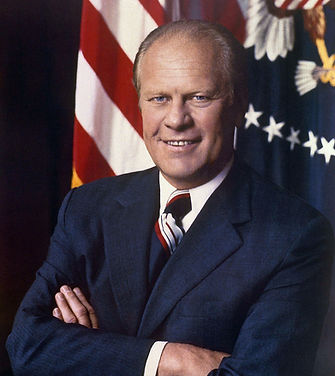
Gerald Ford
Gerald Rudolph Ford Jr. (1913–2006) was the 38th president of the United States and the only person to serve as president without being elected either president or vice president by the American people. Born in Omaha, Nebraska, and raised in Grand Rapids, Michigan, Ford developed a reputation for integrity, moderation, and personal decency during a long career in public service. He served in the U.S. House of Representatives for nearly 25 years, became vice president after the resignation of Spiro Agnew in 1973, and assumed the presidency in August 1974 following Richard Nixon’s resignation amid the Watergate scandal. His presidency was dominated by the difficult task of restoring public confidence in government, managing economic problems, and healing a deeply divided nation after the political turmoil of the early 1970s.
Ford was born on July 14, 1913, in Omaha, Nebraska, as Leslie Lynch King Jr., the son of Leslie Lynch King Sr. and Dorothy Ayer Gardner King. His parents separated shortly after his birth, and his mother moved with him to Grand Rapids, Michigan, where she later married Gerald Rudolff Ford, a successful businessman. Ford was subsequently known as Gerald Rudolff Ford Jr., although he never formally changed his middle name from Rudolph. He excelled in school and athletics, particularly football, and attended the University of Michigan, where he became a star player on undefeated national championship teams in 1932 and 1933. After graduating in 1935, he turned down professional football opportunities to attend Yale Law School, where he earned his law degree in 1941. His youth helped shape the disciplined, competitive, and straightforward personality that later became central to his political reputation.
Ford began practicing law in Grand Rapids in 1941, but his career was interrupted by World War II. After the United States entered the war, he served in the U.S. Navy from 1942 to 1946, eventually becoming a lieutenant commander and serving aboard the aircraft carrier USS Monterey in the Pacific. After returning home, Ford became increasingly involved in Republican politics and was elected to the U.S. House of Representatives in 1948, representing Michigan’s 5th congressional district. He became a prominent member of the Republican minority and developed a reputation as a pragmatic legislator who emphasized fiscal responsibility, national defense, and cooperation across party lines. Ford eventually became chairman of the House Republican Conference and, in 1965, House Minority Leader. Although he never sought the presidency himself, his reputation as a respected congressional leader made him an important figure during a period of growing political instability.
Ford became president under extraordinary circumstances. Vice President Spiro Agnew resigned in October 1973 after pleading no contest to charges related to tax evasion and political corruption, and President Richard Nixon nominated Ford to replace him under the Twenty-Fifth Amendment. Ford was confirmed by Congress and became vice president in December 1973. Only eight months later, Nixon resigned on August 9, 1974, making Ford president. He immediately declared that the nation’s long political nightmare was over, but his decision to pardon Nixon one month later became one of the most controversial acts of his presidency. Ford also confronted severe inflation, unemployment, energy shortages, and economic stagnation. His administration promoted the WIN—“Whip Inflation Now”—campaign, sought to restrain government spending, and dealt with major foreign-policy challenges involving the Soviet Union, China, and the aftermath of the Vietnam War. In 1975, Ford narrowly survived two assassination attempts by women acting separately within a seventeen-day period. He also signed the Helsinki Accords, which helped improve relations between the United States and the Soviet Union while establishing principles concerning European security and human rights. In the 1976 election, Ford won the Republican nomination but narrowly lost to Democratic nominee Jimmy Carter.
After leaving office in January 1977, Ford remained active in public life and gradually became one of the most respected former presidents in the country. He established the Gerald R. Ford Presidential Library and Museum and participated in conferences, speeches, and civic activities. Although the Nixon pardon remained controversial for many years, Ford continued to defend his decision as necessary to prevent the country from becoming consumed by another lengthy political and legal crisis. In the decades after his presidency, public opinion increasingly viewed Ford as an honorable and stabilizing figure who had inherited an extraordinarily difficult situation. He maintained friendships with political figures from both parties and was frequently praised for his willingness to place national unity above personal political advantage. In 2001, he received the John F. Kennedy Profile in Courage Award, and in 2003 he was awarded the Presidential Medal of Freedom.
Gerald Ford died on December 26, 2006, at his home in Rancho Mirage, California, at the age of 93, making him the longest-lived U.S. president at the time. He was buried at the Gerald R. Ford Presidential Museum in Grand Rapids, Michigan, following a state funeral attended by numerous political leaders and former presidents. Ford's legacy is closely associated with the extraordinary circumstances of his rise to the presidency and his effort to restore stability after Watergate. His presidency is often ranked as relatively undistinguished in terms of major legislative achievements, but historians and the public have increasingly recognized the importance of his steady leadership during a constitutional and political crisis. Ford's greatest contribution may have been his restoration of normal constitutional government: he inherited a nation deeply distrustful of its leaders and left office having helped demonstrate that the presidency could once again be conducted with honesty, restraint, and respect for democratic institutions.