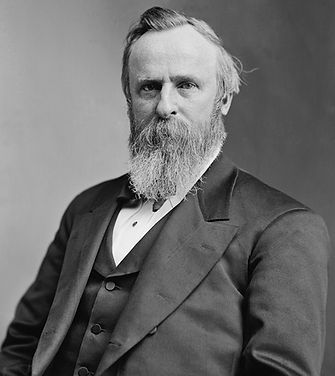
Rutherford B. Hayes
Rutherford Birchard Hayes, the 19th president of the United States, was born on October 4, 1822, in Delaware, Ohio, and died on January 17, 1893. A lawyer, Union general, congressman, and three-term governor of Ohio, Hayes entered the presidency with a reputation for personal integrity and reform-minded Republicanism. His presidency came at a pivotal moment: the nation was emerging from the Civil War and Reconstruction while entering an era of rapid industrialization, and Hayes's controversial victory in the disputed election of 1876 made his administration one of the most debated in American history.
Hayes's youth was shaped by both hardship and opportunity. His father died approximately ten weeks before his birth, leaving his mother, Sophia, to raise him and his older sister, Fanny. Despite these early losses, Hayes received an excellent education, attending private schools before entering Kenyon College, where he graduated as valedictorian in 1842. He subsequently attended Harvard Law School, graduating in 1845 and entering the Ohio bar that same year. After initially struggling to establish himself as a lawyer in Lower Sandusky, Hayes moved to Cincinnati in 1849, where he eventually became a successful criminal defense attorney. In 1852, he married Lucy Ware Webb, whose strong religious convictions, abolitionist sympathies, and commitment to temperance would have a major influence on his life.
Hayes's early career was transformed by the political crisis over slavery and the Civil War. Although initially more focused on his legal practice than politics, he became a Republican and increasingly opposed the expansion of slavery. When the Civil War began in 1861, nearly forty-year-old Hayes volunteered for the Union Army despite having a family and no previous military experience. He rose from major to brigadier general and was wounded several times, earning a reputation for personal courage and leadership, particularly during the Shenandoah Valley campaigns. While still serving in the army, he was elected to the U.S. House of Representatives in 1864, refusing to leave his military post to campaign. After the war, he served in Congress from 1865 to 1867 and then became governor of Ohio, serving from 1868 to 1872 and again from 1876 until his inauguration as president. As governor, he supported Reconstruction and voting rights for African Americans and promoted education and government reform.
Hayes's presidency began under extraordinary circumstances following the disputed election of 1876. Although Democrat Samuel J. Tilden won more of the popular vote, the electoral votes of Louisiana, Florida, and South Carolina were contested, and a special Electoral Commission ultimately awarded the disputed votes to Hayes, giving him the presidency by a single electoral vote. His opponents accused Republicans of stealing the election, and Hayes became known derisively as "Rutherfraud." Once in office, Hayes sought to restore public confidence in government through civil service reform, opposition to political patronage, and a stronger executive branch. He also ended the federal military presence that had sustained Republican governments in the remaining Reconstruction states, effectively bringing Reconstruction to a close. At the same time, Hayes supported the gold standard, opposed efforts to inflate the currency, confronted powerful Republican senators over patronage, and promoted competitive examinations for government positions. His presidency was relatively quiet compared with those of Lincoln or Grant, but his efforts helped strengthen presidential authority and laid groundwork for the broader civil service reforms that followed his administration.
True to a promise he had made during the 1876 campaign, Hayes served only one term and retired from the presidency in March 1881. He returned to his Ohio home, Spiegel Grove, where he remained active in public affairs rather than withdrawing completely from civic life. Education became one of his principal causes, and he advocated universal public education and improved educational opportunities for both Black and white Americans, particularly in the South. He also became increasingly concerned about poverty, inequality, prison conditions, and the growing power of large corporations during America's industrialization. Hayes supported prison reform, opposed the death penalty, and argued that education could help address poverty and crime. His retirement was unusually active for a former president, and he continued writing, speaking, traveling, and supporting educational and social reforms until the end of his life.
Hayes was deeply affected by the death of his wife, Lucy, who died from a stroke in 1889, but he continued his public work for several years afterward. He died of heart disease on January 17, 1893, at the age of seventy, and was buried at Spiegel Grove in Fremont, Ohio. His legacy is complicated: his administration helped restore presidential authority and advanced civil service reform, but his withdrawal of federal troops from the South contributed to the collapse of Reconstruction and left African Americans increasingly vulnerable to disenfranchisement and segregation. Nevertheless, historians generally recognize Hayes as a conscientious and reform-minded president who confronted a deeply divided country and attempted to move it beyond the corruption and sectional conflict of the post-Civil War period. His presidency is therefore remembered both for the controversy surrounding its beginning and for the reforms and institutional changes that outlasted his single term.