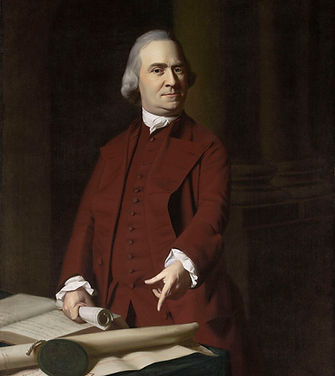
Samuel Adams
Samuel Adams (1722–1803) was an American revolutionary, political writer, statesman, and Founding Father who became one of the most influential leaders of the Patriot movement in Boston. A second cousin of future President John Adams, Samuel Adams was a major opponent of British taxation and imperial authority and helped transform colonial resistance into an organized movement for independence. He served in the Massachusetts legislature, participated in the Continental Congress, signed the Declaration of Independence, helped shape the Massachusetts Constitution, and ultimately served as governor of Massachusetts.
Adams was born in Boston on September 27, 1722, into a prosperous and politically active Puritan family. His father, Samuel Adams Sr., was a successful maltster and an influential participant in Boston politics, exposing his son from an early age to ideas about self-government and civic responsibility. Adams attended Boston Latin School before entering Harvard College in 1736, graduating in 1740 and receiving a master's degree in 1743. His master's thesis asked whether it was lawful to resist a supreme magistrate when the commonwealth could not otherwise be preserved, foreshadowing the political principles that would define his life.
After Harvard, Adams struggled to establish himself financially, trying several occupations before finding his true calling in politics. He attempted business, worked in his father's malt house, and served as Boston's tax collector beginning in 1756, although he was not particularly successful as a businessman or administrator. Adams increasingly devoted himself to political writing and local government, becoming a clerk of the Boston Market and contributing to newspapers that defended colonial rights. In 1765, he entered the Massachusetts House of Representatives, where he became a leading opponent of the Stamp Act and later British taxation, using petitions, newspaper essays, town meetings, and committees of correspondence to mobilize public resistance.
Adams became one of the most important organizers of the American Revolution in Boston. He opposed the Townshend Acts, helped organize resistance to British policies, and played a prominent role in the political events surrounding the Boston Massacre and the Boston Tea Party. He was a delegate to the Continental Congress beginning in 1774 and strongly supported independence as relations with Britain deteriorated into war. Adams signed the Declaration of Independence in 1776 and remained in Congress during the early years of the Revolution, later helping with the Articles of Confederation. He returned to Massachusetts in 1779 and, alongside John Adams and James Bowdoin, helped draft the Massachusetts Constitution, which was ratified in 1780.
After the Revolution, Adams concentrated increasingly on Massachusetts politics. He served as president of the Massachusetts Senate and participated in the state's constitutional and political affairs before becoming lieutenant governor in 1789 under Governor John Hancock. When Hancock died in 1793, Adams assumed the governorship and was subsequently elected to three additional one-year terms, serving until 1797. As governor, he supported the principles of republican government and worked to maintain a balance between state and federal authority during the early years of the new American republic. After leaving office in 1797, he retired from public political life.
Samuel Adams died in Boston on October 2, 1803, at the age of 81 and was buried at the Granary Burying Ground. His legacy rests less on holding high national office than on his ability to organize public opinion and turn political principles into sustained popular action. Adams helped establish the language and political networks through which Massachusetts resistance to British rule became part of a broader American independence movement, making him one of the central political organizers of the Revolution. Although later generations sometimes portrayed him primarily as a fiery propagandist, his contemporaries and later admirers also recognized him as a committed political thinker who placed liberty, self-government, and civic virtue at the center of his public life.