
- Nov 2, 2025
- 17 min read
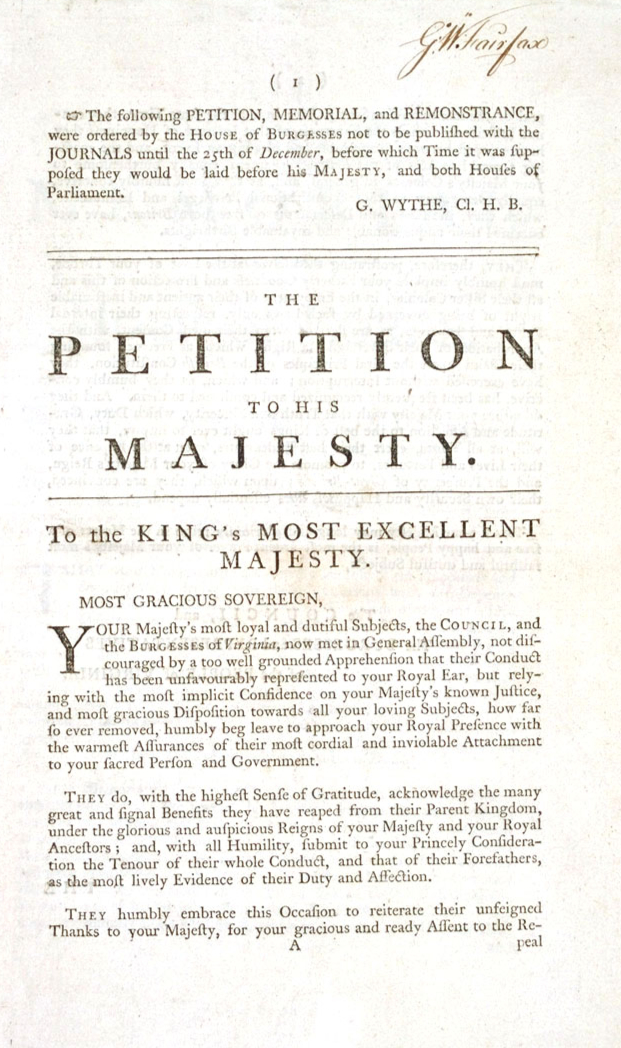
THE
PETITION
TO HIS
MAJESTY.
To the KING's MOST EXCELLENT
MAJESTY.
MOST GRACIOUS SOVEREIGN,
YOUR Majesty's most loyal and dutiful Subjects, the COUNCIL, and the BURGESSES of Virginia, now met in General Assembly, not discouraged by a too well grounded Apprehension that their Conduct has been unfavourably represented to your Royal Ear, but relying with the most implicit Confidence on your Majesty's known Justice, and most gracious Disposition towards all your loving Subjects, how far so ever removed, humbly beg leave to approach your Royal Presence with the warmest Assurances of their most cordial and inviolable Attachment to your sacred Person and Government.
THEY do, with the highest Sense of Gratitude, acknowledge the many great and signal Benefits they have reaped from their Parent Kingdom, under the glorious and auspicious Reigns of your Majesty and your Royal Ancestors ; and, with all Humility, submit to your Princely Consideration the Tenour of their whole Conduct, and that of their Forefathers, as the most lively Evidence of their Duty and Affection.
THEY humbly embrace this Occasion to reiterate their unfeigned Thanks to your Majesty, for your gracious and ready Assent to the repeal of the late oppressive Stamp-Act; but, at the fame Time, they cannot sufficiently lament the Shortness of that Interval of Happiness they have enjoyed between so agreeable and pleasing an Event, and the enacting several late Acts of the British Parliament, equally burthensome to your Majesty's Colonies in general, and, as they most humbly conceive, equally derogatory to those constitutional Privileges and Immunities, which they, the Heirs and Descendants of free born Britons, have ever esteemed their unquestionable and invaluable Birthrights.
THEY, therefore, prostrating themselves at the Foot of your Throne, most humbly implore your Fatherly Goodness and Protection of this and all their Sifter Colonies, in the Enjoyment of their antient and inestimable Right of being governed by such Laws only, respecting their internal Polity and Taxation, as are derived from their own Consent, with the Approbation of their Sovereign ; a Right, which, as Freemen founding their Claim upon the vital Principles of the British Constitution, they have exercised without Interruption ; and which, as they humbly conceive, has been frequently recognized and confirmed to them. And they do assure your Majesty with that Truth and Sincerity, which Duty, Gratitude and Affection to the best of Kings ought ever to inspire, that they will, at all Times, exert their best Endeavours, even at the Expence of their Lives and Fortunes, to promote the Glory of your Majesty's Reign, and the Prosperity of Great-Britain; upon which, they are convinced, their own Security and Happiness does essentially depend.
THAT your Majesty may long and gloriously reign in the Hearts of a free and happy People, is the most ardent Prayer of your Majesty's most faithful and dutiful Subjects,
The COUNCIL, and
The BURGESSES and REPRESENTATIVES
of the PEOPLE of VIRGINIA.
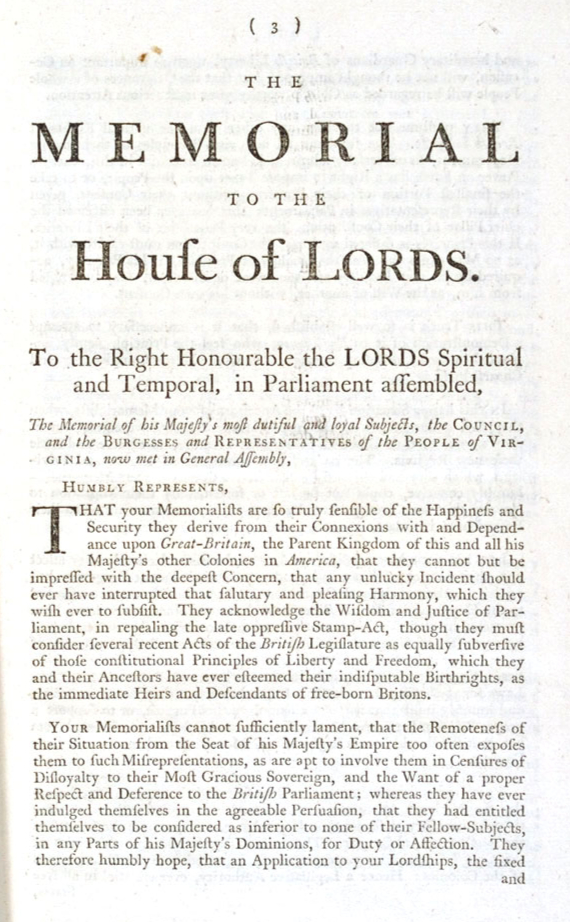
THE
MEMORIAL
TO THE
House of LORDS.
To the Right Honourable the LORDS Spiritual
and Temporal, in Parliament assembled,
The Memorial of bis Majesty's most dutiful and loyal Subjects, the COUNCIL, and the BURGESSES and REPRESENTATIVES of the PEOPLE of VIRGINIA, now met in General Assembly,
Humbly Represents,
THAT your Memorialists are so truly sensible of the Happiness and Security they derive from their Connexions with and Dependance upon Great-Britain, the Parent Kingdom of this and all his Majesty's other Colonies in America, that they cannot but be impressed with the deepest Concern, that any unlucky Incident should ever have interrupted that salutary and pleasing Harmony, which they wish ever to subsist. They acknowledge the Wisdom and Justice of Parliament, in repealing the late oppressive Stamp-Act, though they must confider several recent Acts of the British Legislature as equally subversive of those constitutional Principles of Liberty and Freedom, which they and their Ancestors have ever esteemed their indisputable Birthrights, as the immediate Heirs and Descendants of free-born Britons.
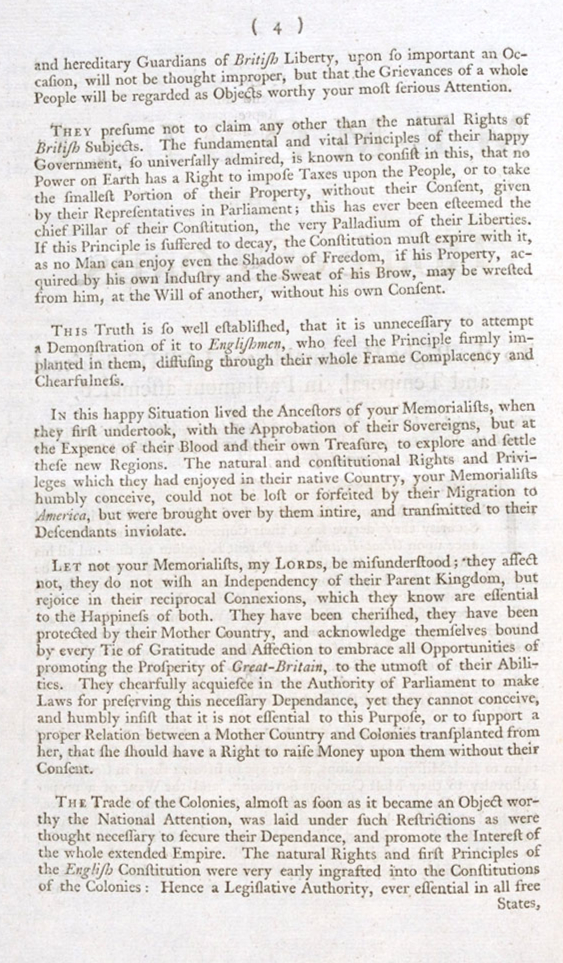
YOUR Memorialists cannot sufficiently lament, that the Remoteness of their Situation from the Seat of his Majesty's Empire too often exposes them to such Misrepresentations, as are apt to involve them in Censures of Disloyalty to their Most Gracious Sovereign, and the Want of a proper Respect and Deference to the British Parliament; whereas they have ever indulged themselves in the agreeable Persuasion, that they had entitled themselves to be considered as inferior to none of their Fellow-Subjects, in any Parts of his Majesty's Dominions, for Duty or Affection. They therefore humbly hope, that an Application to your Lordships, the fixed and hereditary Guardians of British Liberty, upon so important an Occasion, will not be thought improper, but that the Grievances of a whole People will be regarded as Objects worthy your most serious Attention.
THEY presume not to claim any other than the natural Rights of British Subjects. The fundamental and vital Principles of their happy Government, so universally admired, is known to consist in this, that no Power on Earth has a Right to impose Taxes upon the People, or to take the smallest Portion of their Property, without their Consent, given by their Representatives in Parliament; this has ever been esteemed the chief Pillar of their Constitution, the very Palladium of their Liberties. If this Principle is suffered to decay, the Constitution must expire with it, as no Man can enjoy even the Shadow of Freedom, if his Property, acquired by his own Industry and the Sweat of his Brow, may be wrested from him, at the Will of another, without his own Consent.
THIS Truth is so well established, that it is unnecessary to attempt a Demonstration of it to Englishmen, who feel the Principle firmly implanted in them, diffusing through their whole Frame Complacency and Chearfulness.
IN this happy Situation lived the Ancestors of your Memorialists, when they first undertook, with the Approbation of their Sovereigns, but at the Expence of their Blood and their own Treasure, to explore and fettle these new Regions. The natural and constitutional Rights and Privileges which they had enjoyed in their native Country, your Memorialists humbly conceive, could not be loft or forfeited by their Migration to America, but were brought over by them intire, and transmitted to their Descendants inviolate.
LET not your Memorialists, my LORDS, be misunderstood; they affect not, they do not wish an Independency of their Parent Kingdom, but rejoice in their reciprocal Connexions, which they know are essential to the Happiness of both. They have been cherished, they have been protected by their Mother Country, and acknowledge themselves bound by every Tie of Gratitude and Affection to embrace all Opportunities of promoting the Prosperity of Great-Britain, to the utmost of their Abilities. They chearfully acquiesce in the Authority of Parliament to make Laws for preserving this necessary Dependance, yet they cannot conceive, and humbly insist that it is not essential to this Purpose, or to support a proper Relation between a Mother Country and Colonies transplanted from her, that she should have a Right to raise Money upon them without their Consent.
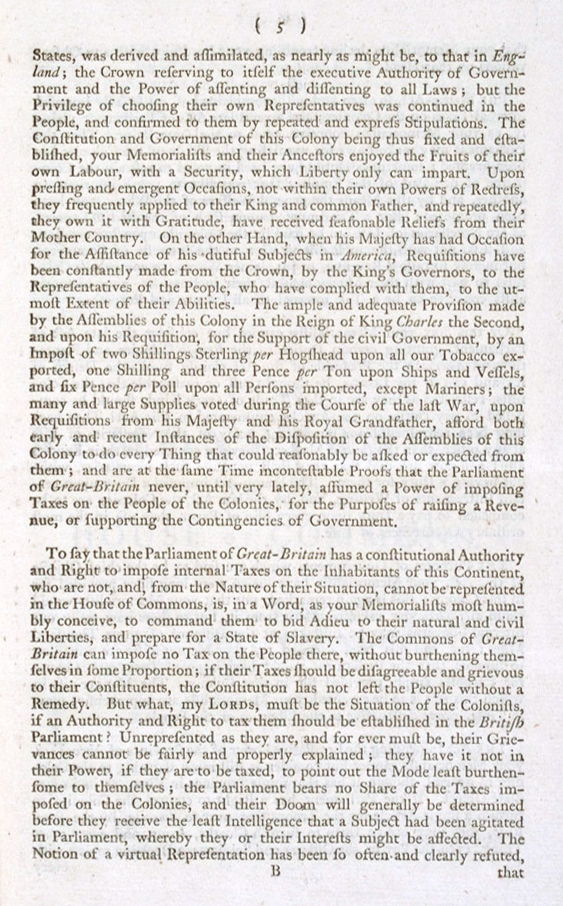
THE Trade of the Colonies, almost as soon as it became an Object worthy the National Attention, was laid under such Restrictions as were thought necessary to secure their Dependance, and promote the Interest of the whole extended Empire. The natural Rights and first Principles of the English Constitution were very early ingrafted into the Constitutions of the Colonies : Hence a Legislative Authority, ever essential in all free States, was derived and assimilated, as nearly as might be, to that in England; the Crown reserving to itself the executive Authority of Government and the Power of assenting and dissenting to all Laws; but the Privilege of choosing their own Representatives was continued in the People, and confirmed to them by repeated and express Stipulations. The Constitution and Government of this Colony being thus fixed and established, your Memorialists and their Ancestors enjoyed the Fruits of their own Labour, with a Security, which Liberty only can impart. Upon pressing and emergent Occasions, not within their own Powers of Redress, they frequently applied to their King and common Father, and repeatedly, they own it with Gratitude, have received reasonable Reliefs from their Mother Country. On the other Hand, when his Majesty has had Occasion for the Assistance of his dutiful Subjects in America, Requisitions have been constantly made from the Crown, by the King's Governors, to the Representatives of the People, who have complied with them, to the utmost Extent of their Abilities. The ample and adequate Provision made by the Assemblies of this Colony in the Reign of King Charles the Second, and upon his Requisition, for the Support of the civil Government, by an Impost of two Shillings Sterling per Hogthead upon all our Tobacco exported, one Shilling and three Pence per Ton upon Ships and Vessels, and fix Pence per Poll upon all Persons imported, except Mariners; the many and large Supplies voted during the Course of the last War, upon Requisitions from his Majesty and his Royal Grandfather, afford both early and recent Instances of the Disposition of the Assemblies of this Colony to do every Thing that could reasonably be asked or expected from them; and are at the fame Time incontestable Proofs that the Parliament of Great-Britain never, until very lately, assumed a Power of imposing Taxes on the People of the Colonies, for the Purposes of raising a Revenue, or supporting the Contingencies of Government.
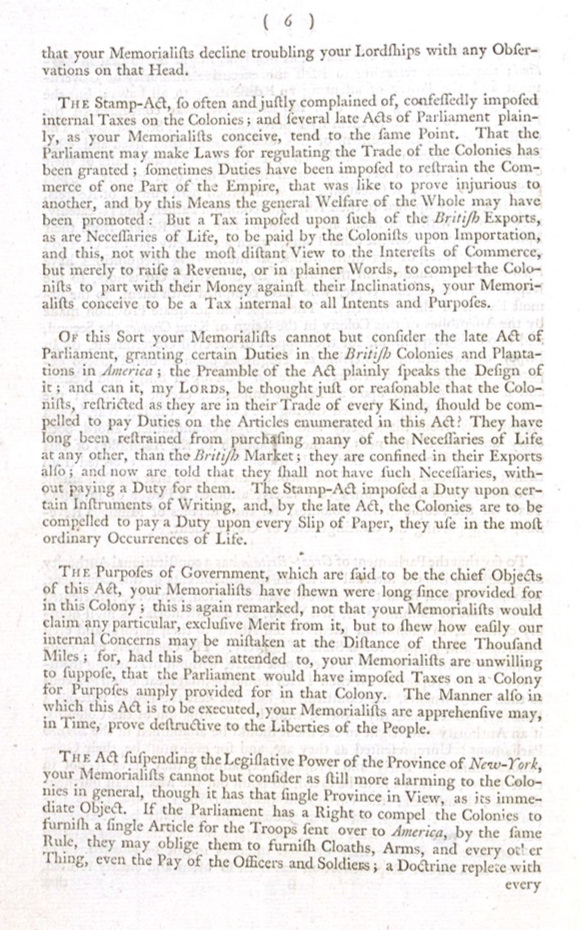
To fay that the Parliament of Great-Britain has a constitutional Authority and Right to impose internal Taxes on the Inhabitants of this Continent, who are not, and, from the Nature of their Situation, cannot be represented in the House of Commons, is, in a Word, as your Memorialists most humbly conceive, to command them to bid Adieu to their natural and civil Liberties, and prepare for a State of Slavery. The Commons of Great-Britain can impose no Tax on the People there, without burthening themselves in some Proportion; if their Taxes should be disagreeable and grievous to their Constituents, the Constitution has not left the People without a Remedy. But what, my LORDS, must be the Situation of the Colonists, if an Authority and Right to tax them should be established in the British Parliament? Unrepresented as they are, and for ever must be, their Grievances cannot be fairly and properly explained ; they have it not in their Power, if they are to be taxed, to point out the Mode least burthensome to themselves; the Parliament bears no Share of the Taxes imposed on the Colonies, and their Doom will generally be determined before they receive the least Intelligence that a Subject had been agitated in Parliament, whereby they or their Interests might be affected. The Notion of a virtual Representation has been so often and clearly refuted, that your Memorialists decline troubling your Lordships with any Observations on that Head.
THE Stamp-Act, so often and justly complained of, confessedly imposed internal Taxes on the Colonies; and several late Acts of Parliament plainly, as your Memorialists conceive, tend to the fame Point. That the Parliament may make Laws for regulating the Trade of the Colonies has been granted; sometimes Duties have been imposed to restrain the Commerce of one Part of the Empire, that was like to prove injurious to another, and by this Means the general Welfare of the Whole may have been promoted: But a Tax imposed upon such of the British Exports, as are Necessaries of Life, to be paid by the Colonists upon Importation, and this, not with the most distant View to the Interests of Commerce, but merely to raise a Revenue, or in plainer Words, to compel the Colonists to part with their Money against their Inclinations, your Memorialists conceive to be a Tax internal to all Intents and Purposes.
Or this Sort your Memorialists cannot but confider the late Act of Parliament, granting certain Duties in the British Colonies and Plantations in America ; the Preamble of the Act plainly speaks the Design of it; and can it, my LORDS, be thought just or reasonable that the Colonists, restricted as they are in their Trade of every Kind, should be compelled to pay Duties on the Articles enumerated in this Act? They have long been restrained from purchasing many of the Necessaries of Life at any other, than the British Market; they are confined in their Exports also; and now are told that they shall not have such Necessaries, without paying a Duty for them. The Stamp-Act imposed a Duty upon certain Instruments of Writing, and, by the late Act, the Colonies are to be compelled to pay a Duty upon every Slip of Paper, they use in the most ordinary Occurrences of Life.
THE Purposes of Government, which are said to be the chief Objects of this Act, your Memorialists have shewn were long since provided for in this Colony ; this is again remarked, not that your Memorialists would claim any particular, exclusive Merit from it, but to shew how easily our internal Concerns may be mistaken at the Distance of three Thousand Miles ; for, had this been attended to, your Memorialists are unwilling to suppose, that the Parliament would have imposed Taxes on a Colony for Purposes amply provided for in that Colony. The Manner also in which this Act is to be executed, your Memorialists are apprehensive may, in Time, prove destructive to the Liberties of the People.
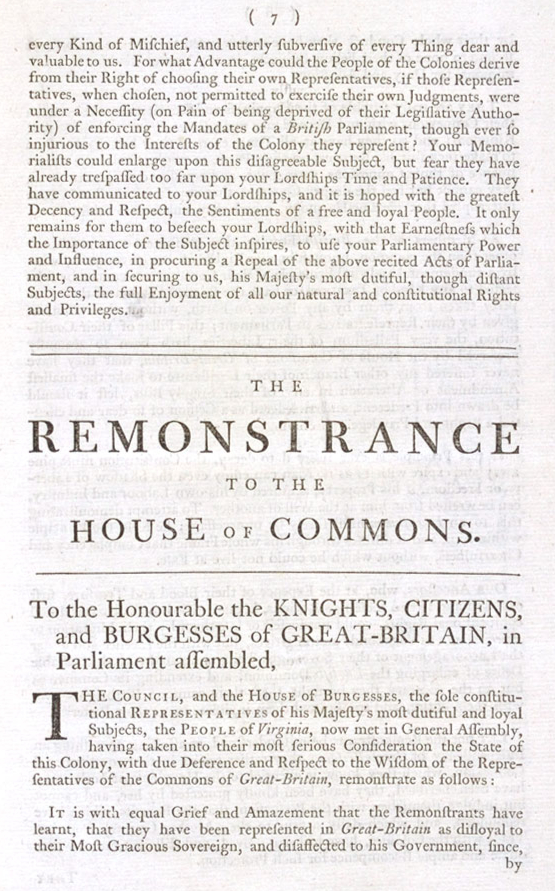
THE Act suspending the Legislative Power of the Province of New-York, your Memorialists cannot but confider as still more alarming to the Colonies in general, though it has that single Province in View, as its immediate Object. If the Parliament has a Right to compel the Colonies to furnish a single Article for the Troops fent over to America, by the fame Rule, they may oblige them to furnish Cloaths, Arms, and every otter Thing, even the Pay of the Officers and Soldiers; a Doctrine replete with every Kind of Mischief, and utterly subversive of every Thing dear and valuable to us. For what Advantage could the People of the Colonies derive from their Right of choosing their own Representatives, if those Representatives, when chosen, not permitted to exercise their own Judgments, were under a Necessity (on Pain of being deprived of their Legislative Authority) of enforcing the Mandates of a British Parliament, though ever so injurious to the Interests of the Colony they represent? Your Memorialists could enlarge upon this disagreeable Subject, but fear they have already trespassed too far upon your Lordships Time and Patience. They have communicated to your Lordships, and it is hoped with the greatest Decency and Respect, the Sentiments of a free and loyal People. It only remains for them to beseech your Lordships, with that Earnestness which the Importance of the Subject inspires, to use your Parliamentary Power and Influence, in procuring a Repeal of the above recited Acts of Parliament, and in securing to us, his Majesty's most dutiful, though distant Subjects, the full Enjoyment and Privileges.
THE
REMONSTRANCE
TO THE
HOUSE of COMMONS.
To the Honourable the KNIGHTS, CITIZENS, and BURGESSES of GREAT-BRITAIN, in Parliament assembled,
THE COUNCIL, and the HOUSE of BURGESSES, the sole constitutional REPRESENTATIVES of his Majesty's most dutiful and loyal Subjects, the PEOPLE of Virginia, now met in General Assembly, having taken into their most serious Consideration the State of this Colony, with due Deference and Respect to the Wisdom of the Representatives of the Commons of Great-Britain, remonstrate as follows:
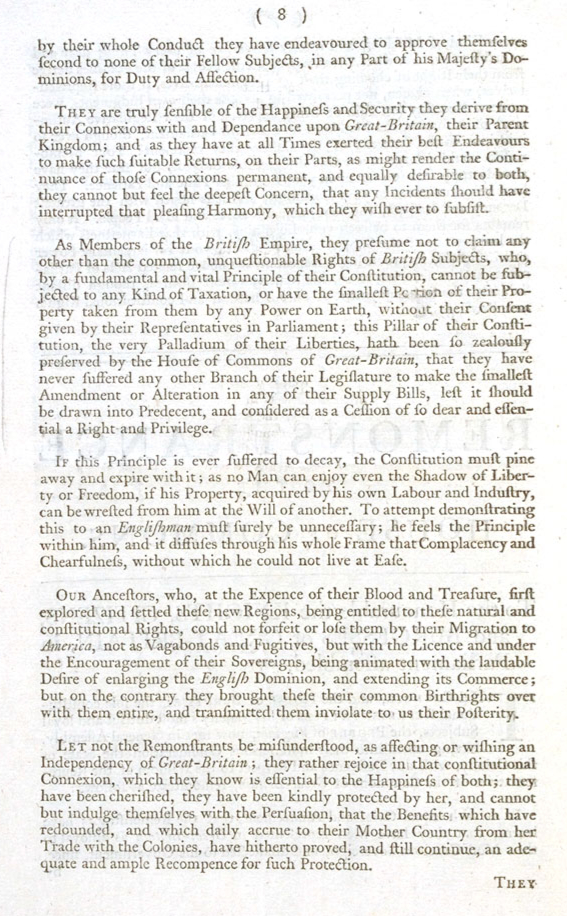
IT is with equal Grief and Amazement that the Remonstrants have learnt, that they have been represented in Great-Britain as disloyal to their Most Gracious Sovereign, and disaffected to his Government, since, by their whole Conduct they have endeavoured to approve themselves second to none of their Fellow Subjects, in any Part of his Majesty's Dominions, for Duty and Affection.
THEY are truly sensible of the Happiness and Security they derive from their Connexions with and Dependance upon Great-Britain, their Parent Kingdom; and as they have at all Times exerted their best Endeavours to make such suitable Returns, on their Parts, as might render the Continuance of those Connexions permanent, and equally desirable to both, they cannot but feel the deepest Concern, that any Incidents should have interrupted that pleasing Harmony, which they wish ever to subsist.
As Members of the British Empire, they presume not to claim any other than the common, unquestionable Rights of British Subjects, who, by a fundamental and vital Principle of their Constitution, cannot be subjected to any Kind of Taxation, or have the smallest Portion of their Property taken from them by any Power on Earth, without their Consent given by their Representatives in Parliament; this Pillar of their Constitution, the very Palladium of their Liberties, hath been so zealously preserved by the House of Commons of Great-Britain, that they have never suffered any other Branch of their Legislature to make the smallest Amendment or Alteration in any of their Supply Bills, left it should be drawn into Precedent, and considered as a Coffin of so dear and essential a Right and Privilege.
If this Principle is ever suffered to decay, the Constitution must pine away and expire with it ; as no Man can enjoy even the Shadow of Liberty or Freedom, if his Property, acquired by his own Labour and Industry, can be wrested from him at the Will of another. To attempt demonstrating this to an Englishman must surely be unnecessary; he feels the Principle within him, and it diffuses through his whole Frame that Complacency and Chearfulness, without which he could not live at Ease.
OUR Ancestors, who, at the Expence of their Blood and Treasure, first explored and fettled these new Regions, being entitled to these natural and constitutional Rights, could not forfeit or lose them by their Migration to America, not as Vagabonds and Fugitives, but with the License and under the Encouragement of their Sovereigns, being animated with the laudable Desire of enlarging the English Dominion, and extending its Commerce; but on the contrary they brought these their common Birthrights over with them entire, and transmitted them inviolate to us their Posterity.
LET not the Remonstrants be misunderstood, as affecting or wishing an Independency of Great-Britain ; they rather rejoice in that constitutional Connexion, which they know is essential to the Happiness of both; they have been cherished, they have been kindly protected by her, and cannot but indulge themselves with the Persuasion, that the Benefits which have redounded, and which daily accrue to their Mother Country from her Trade with the Colonies, have hitherto proved, and quate and ample Recompence for such Protection.
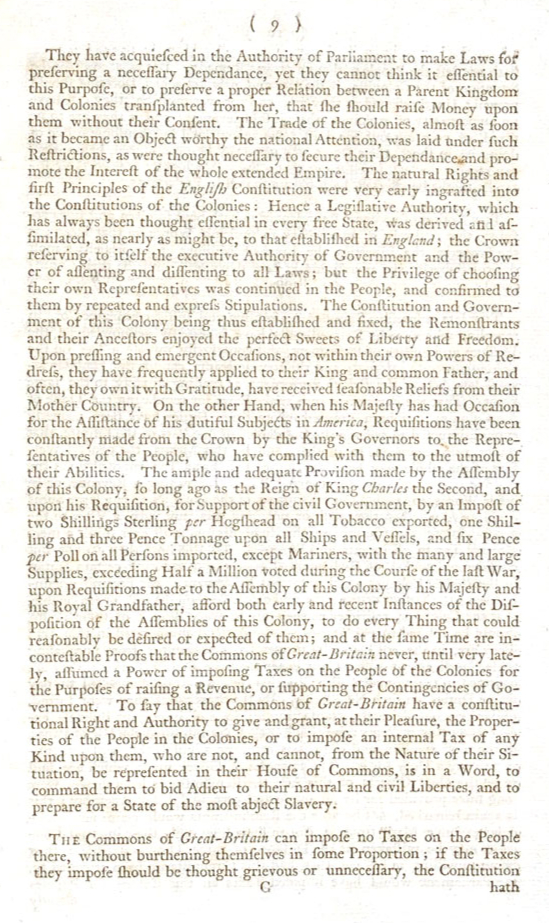
They have acquiesced in the Authority of Parliament to make Laws for preserving a necessary Dependance, yet they cannot think it essential to this Purpose, or to preserve a proper Relation between a Parent Kingdom and Colonies transplanted from her, that she should raise Money upon them without their Consent. The Trade of the Colonies, almost as soon as it became an Object worthy the national Attention, was laid under such Restrictions, as were thought necessary to secure their Dependance and promote the Interest of the whole extended Empire. The natural Rights and first Principles of the English Constitution were very early ingrafted into the Constitutions of the Colonies: Hence a Legislative Authority, which has always been thought essential in every free State, was derived and assimilated, as nearly as might be, to that established in England; the Crown reserving to itself the executive Authority of Government and the Power of assenting and dissenting to all Laws; but the Privilege of choosing their own Representatives was continued in the People, and confirmed to them by repeated and express Stipulations. The Constitution and Government of this Colony being thus established and fixed, the Remonstrants and their Ancestors enjoyed the perfect Sweets of Liberty and Freedom.
Upon pressing and emergent Occasions, not within their own Powers of Redress, they have frequently applied to their King and common Father, and often, they own it with Gratitude, have received reasonable Reliefs from their Mother Country. On the other Hand, when his Majesty has had Occasion for the Affiftance of his dutiful Subjects in America, Requisitions have been constantly made from the Crown by the King's Governors to the Representatives of the People, who have complied with them to the utmost of their Abilities. The ample and adequate Provision made by the Assembly of this Colony, so long ago as the Reign of King Charles the Second, and upon his Requisition, for Support of the civil Government, by an Impost of two Shillings Sterling per Hogshead on all Tobacco exported, one Shilling and three Pence Tonnage upon all Ships and Vessels, and fix Pence per Poll on all Persons imported, except Mariners, with the many and large Supplies, exceeding Half a Million voted during the Course of the last War, upon Requisitions made to the Assembly of this Colony by his Majesty and his Royal Grandfather, afford both early and recent Instances of the Disposition of the Assemblies of this Colony, to do every Thing that could reasonably be desired or expected of them; and at the fame Time are incontestable Proofs that the Commons of Great-Britain never, until very lately, assumed a Power of imposing Taxes on the People of the Colonies for the Purposes of raising a Revenue, or supporting the Contingencies of Government. To fay that the Commons of Great-Britain have a constitutional Right and Authority to give and grant, at their Pleasure, the Properties of the People in the Colonies, or to impose an internal Tax of any Kind upon them, who are not, and cannot, from the Nature of their Situation, be represented in their House of Commons, is in a Word, to command them to bid Adieu to their natural and civil Liberties, and to prepare for a State of the most abject Slavery.
THE Commons of Great-Britain can impose no Taxes on the People there, without burthening themselves in some Proportion ; if the Taxes they impose should be thought grievous or unnecessary, the Constitution hath not left the People without a proper Remedy. But what must be the Situation of the Colonists, if the late and new broached Doctrine should prevail? Unrepresented as they are, and for ever must be, they can have no Opportunity of explaining their just Grievances; and if they are to be taxed, of pointing out the least inconvenient and burthensome Mode of doing it; in short, their Doom will generally be pronounced, before they can receive the least Intelligence that a Subject, whereby they or their Interests might be affected, hath been agitated in Parliament.
THE Notion of a virtual Representation hath been so often and fully refuted, that it surely is unnecessary to multiply Words on that Head ; if the Property, the Liberties, the Lives of Millions of his Majesty's most dutiful Subjects are merely ideal, how deplorable must be their Condition!
THE late oppressive Stamp-Act, so often and justly complained of, in repealing which, your Remonstrants have repeatedly acknowledged. the Wisdom and Justice of Parliament, did confessedly impose a Tax on the Colonists merely internal; and the Remonstrants cannot but confider several late Acts of the British Parliament, as tending directly to the fame Point. That the Parliament may make Laws for regulating the Trade of the Colonies, has been granted ; sometimes Duties have been properly enough imposed to restrain the Commerce of one Part of the Empire, that might prove injurious to another; and by this Means, the general Welfare of the whole may have been promoted; but a Tax imposed upon the real Necessaries of Life, for the sole Purpose of raising a Revenue, or in other Words, to compel the Inhabitants of the Colonies to pay large Sums of Money, whether they will or not, and this, not with a View to the general Interests of Commerce, the Remonstrants must ever think a mere internal Tax to all Intents and Purposes. Of this Sort they cannot but confider a late Act of Parliament " giving and granting certain Duties in the British Colonies and Plantations in America ;" the Preamble plainly speaks the Design of the Act; and can it be thought just, or reasonable, that the Colonists, restricted as they are in every Branch of their Trade, should be obliged to pay Duties on the Articles enumerated in this Act?
They are, in the first Place, by former Laws prohibited from purchasing these Necessaries of Life at any other than the British Market ; they are confined in their Exports also ; by this they are to be compelled to pay severe Duties on such Necessaries. By the Stamp-Act they were forbid, under grievous Penalties, transacting all Sorts of important Business, except upon stampt Paper; by this Act they are inhibited the Use of Paper, in the most common and ordinary Occurrences, unless they will first submit to pay a Duty for it. The Purposes of Government, which are said to be the chief Objects of this Act, the Remonstrants have shewn, were long since provided for by an ample and perpetual Act of Assembly ; this is again remarked, not because the Remonstrants would claim any particular exclusive Merit from it, but to shew how easily their internal Concerns may be mistaken at the Distance of three Thousand Miles; they being unwilling to believe, that, had this Circumstance been attended to, the Parliament would have imposed Taxes on this Colony for Purposes already provided for. The Manner in which this Act is to be executed, the Remonstrants cannot but confider as extremely dangerous to the
Liberties of the People.
THE Act suspending the Legislative Power of the Province of New-York, the Remonstrants confider as still more alarming to the Colonies in general, though it has that single Province in View, as its immediate Object. If the Parliament has a Right to compel the Colonists to furnish a single Article for the Troops fent over to America, by the fame Rule of Right they may compel them to furnish Cloaths, Arms, and every other Necessary, even the Pay of the Officers and Soldiers ; a Doctrine replete with every Kind of Mischief, and utterly subversive of all that is dear and valuable to them. For what Advantage could the People of the Colonies derive from their Right of choosing their own Representatives, if those Representatives, when chosen, not permitted to exercise their own Judgments, were under a Necessity (on Pain of being deprived of their Legislative Authority) of enforcing the Mandates of a British Parliament?
THUS have the Remonstrants expressed, and they trust with decent Firmness, the Sentiments of a free and loyal People; it is hoped that the Honourable House of Commons will no longer prosecute Measures, which they, who are designed to suffer under them, must ever consider as much fitter for Exiles, driven from their native Country after having ignominiously forfeited her Favours and Protection, than for the Posterity of Britons, who have been at all Times anxious and sollicitous to demonstrate their Respect and Affection for their Mother Kingdom, by embracing every Occasion to promote her Prosperity and Glory ; but that British Patriots will never consent to the Exercise of anti-constitutional Powers, which even in these remote Corners, may, in Time, prove dangerous in their Example to the interior Parts of the British Empire. Should the Remonstrants be disappointed in these Hopes, the necessary Result will be, that the Colonists, reduced to extreme Poverty, will be compelled to contract themselves within their little Spheres, and obliged to content themselves with their homespun Manufactures.
WILLIAMSBURG:
Printed by WILLIAM RIND, Printer to the Colony
M.DCC.LXIX.












Comments