1685 results found with an empty search
- Lincoln's Second Inaugural
Transcript of President Abraham Lincoln's Second Inaugural Address (1865) Fellow Countrymen At this second appearing to take the oath of the Presidential office there is less occasion for an extended address than there was at the first. Then a statement somewhat in detail of a course to be pursued seemed fitting and proper. Now, at the expiration of four years, during which public declarations have been constantly called forth on every point and phase of the great contest which still absorbs the attention and engrosses the energies of the nation, little that is new could be presented. The progress of our arms, upon which all else chiefly depends, is as well known to the public as to myself, and it is, I trust, reasonably satisfactory and encouraging to all. With high hope for the future, no prediction in regard to it is ventured. On the occasion corresponding to this four years ago all thoughts were anxiously directed to an impending civil war. All dreaded it, all sought to avert it. While the inaugural address was being delivered from this place, devoted altogether to saving the Union without war, insurgent agents were in the city seeking to destroy it without war--seeking to dissolve the Union and divide effects by negotiation. Both parties deprecated war, but one of them would make war rather than let the nation survive, and the other would accept war rather than let it perish, and the war came. One-eighth of the whole population were colored slaves, not distributed generally over the Union, but localized in the southern part of it. These slaves constituted a peculiar and powerful interest. All knew that this interest was somehow the cause of the war. To strengthen, perpetuate, and extend this interest was the object for which the insurgents would rend the Union even by war, while the Government claimed no right to do more than to restrict the territorial enlargement of it. Neither party expected for the war the magnitude or the duration which it has already attained. Neither anticipated that the cause of the conflict might cease with or even before the conflict itself should cease. Each looked for an easier triumph, and a result less fundamental and astounding. Both read the same Bible and pray to the same God, and each invokes His aid against the other. It may seem strange that any men should dare to ask a just God's assistance in wringing their bread from the sweat of other men's faces, but let us judge not, that we be not judged. The prayers of both could not be answered. That of neither has been answered fully. The Almighty has His own purposes. "Woe unto the world because of offenses; for it must needs be that offenses come, but woe to that man by whom the offense cometh." If we shall suppose that American slavery is one of those offenses which, in the providence of God, must needs come, but which, having continued through His appointed time, He now wills to remove, and that He gives to both North and South this terrible war as the woe due to those by whom the offense came, shall we discern therein any departure from those divine attributes which the believers in a living God always ascribe to Him? Fondly do we hope, fervently do we pray, that this mighty scourge of war may speedily pass away. Yet, if God wills that it continue until all the wealth piled by the bondsman's two hundred and fifty years of unrequited toil shall be sunk, and until every drop of blood drawn with the lash shall be paid by another drawn with the sword, as was said three thousand years ago, so still it must be said "the judgments of the Lord are true and righteous altogether." With malice toward none, with charity for all, with firmness in the right as God gives us to see the right, let us strive on to finish the work we are in, to bind up the nation's wounds, to care for him who shall have borne the battle and for his widow and his orphan, to do all which may achieve and cherish a just and lasting peace among ourselves and with all nations. [Endorsed by Lincoln:] Original manuscript of second Inaugeral presented to Major John Hay. A. Lincoln April 10, 1865 Source: https://avalon.law.yale.edu/19th_century/lincoln2.asp
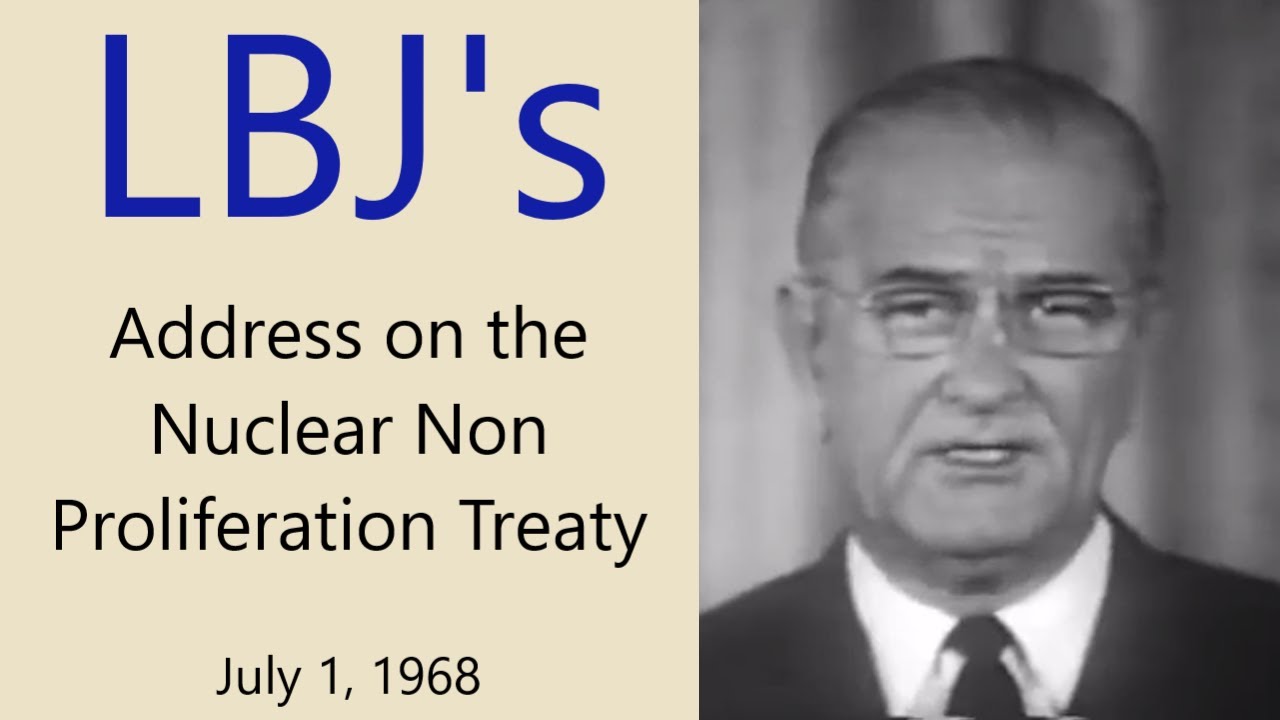
- LBJ's Address and Signing of the Nuclear Non Proliferation Treaty
Secretary Rusk, Your Excellencies, honored Members of Congress, distinguished guests, ladies and gentlemen: This is a very reassuring and hopeful moment in the relations among nations. We have come here today to the East Room of the White House to sign a treaty which limits the spread of nuclear weapons. More than 55 nations are here in Washington this morning to commit their governments to this treaty. Their representatives are also signing today in Moscow and in London. We hope and expect that virtually all the nations will move in the weeks and months ahead to accept this treaty which was commended to the world by the overwhelming majority of the members of the United Nations General Assembly. The treaty's purposes are very simple: —to commit the nations of the world which do not now have nuclear weapons not to produce or receive them in the future; —to assure equally that such nations have the full peaceful benefits of the atom; and —to commit the nuclear powers to move forward toward effective measures of arms control and disarmament. It was just a year ago that Chairman Kosygin and I agreed at Glassboro that we would work intensively in the time ahead to try to achieve this result. After nearly a quarter century of danger and fear—reason and sanity have prevailed to reduce the danger and to greatly lessen the fear. Thus, all mankind is reassured. As the moment is reassuring, so it is, even more, hopeful and heartening. For this treaty is evidence that amid the tensions, the strife, the struggle, and the sorrow of these years, men of many nations have not lost the way—or have not lost the will—toward peace. The conclusion of this treaty encourages the hope that other steps may be taken toward a peaceful world. It is for these reasons—and in this perspective—that I have described this treaty as the most important international agreement since the beginning of the nuclear age. It enhances the security of all nations by significantly reducing the danger of nuclear war among nations. It encourages the peaceful use of nuclear energy by assuring safeguards against its destructive use. But, perhaps most significantly, the signing of this treaty keeps alive and keeps active the impulse toward a safer world. We are inclined to neglect and to overlook what that impulse has brought about in recent years. These have been fruitful times for the quiet works of diplomacy. After long seasons of patient and painstaking negotiation, we have concluded, just within the past 5 years: —the Limited Test Ban Treaty, —the Outer Space Treaty, and —the treaty creating a nuclear-free zone in Latin America. The march of mankind is toward the summit—not the chasm. We must not, we shall not, allow that march to be interrupted. This treaty, like the treaties it follows, is not the work, as Secretary Rusk said, of any one particular nation. It is the accomplishment of nations which seek to exercise their responsibilities for maintaining peace and maintaining a stable world order. It is my hope—and the common will of mankind—that all nations will agree that this treaty affords them some added protection. We hope they will accept the treaty and thereby contribute further to international peace and security. As one of the nations having nuclear weapons, the United States—all through these years—has borne an awesome responsibility. This treaty increases that rest for we have pledged that we shall use our weapons only in conformity with the Charter of the United Nations. Furthermore, we have made clear to United Nations Security Council what would like to repeat today: If a state has accepted this treaty does not have weapons and is a victim of aggression, or is subject to a threat of aggression, involving nuclear weapons, the United States shall prepared to ask immediate Security Council action to provide assistance in accordance with the Charter. In welcoming the treaty that prevents the spread of nuclear weapons, I should like to repeat the United States commitment to honor all our obligations under existing treaties of mutual security. Such agreements have added greatly, we think, to the security of our Nation and the nations with which such agreements exist. They have created a degree of stability in a sometimes unstable world. This treaty is a very important security measure. But it also lays an indispensable foundation: —for expanded cooperation in the peaceful application of nuclear energy; —for additional measures to halt the nuclear arms race. We will cooperate fully to bring the treaty safeguards into being. We shall thus help provide the basis of confidence that is necessary for increased cooperation in the peaceful nuclear field. After the treaty has come into force we will permit the International Atomic Energy Agency to apply its safeguards to all nuclear activities in the United States—excluding only those with direct national security significance. Thus, the United States is not asking any country to accept any safeguards that we are not willing to accept ourselves. As the treaty requires, we shall also engage in the fullest possible exchange of equipment, materials, and scientific and technological information for the peaceful uses of nuclear energy. The needs of the developing nations will be given especially particular attention. We shall make readily available to the nonnuclear treaty partners the benefits of nuclear explosions for peaceful purposes. And we shall do so without delay and under the treaty's provisions. Now at this moment of achievement and great hope, I am gratified to be able to report and announce to the world a significant agreement—an agreement that we have actively sought and worked for since January 1964: Agreement has been reached between the Governments of the Union of Soviet Socialist Republics and the United States to enter in the nearest future into discussions on the limitation and the reduction of both offensive strategic nuclear weapons delivery systems and systems of defense against ballistic missiles. Discussion of this most complex subject will not be easy. We have no illusions that it will be. I know the stubborn, patient persistence that it has required to come this far. We do not underestimate the difficulties that may lie ahead. I know the fears, the suspicions, and the anxieties that we shall have to overcome. But we do believe that the same spirit of accommodation that is reflected in the negotiation of the present treaty can bring us to a good and fruitful result. Man can still shape his destiny in the nuclear age—and learn to live as brothers. Toward that goal—the day when the world moves out of the night of war into the light of sanity and security—I solemnly pledge the resources, the resolve, and the unrelenting efforts of the people of the United States and their Government. Text of the Treaty The States concluding this Treaty, hereinafter referred to as the “Parties to the Treaty”, Considering the devastation that would be visited upon all mankind by a nuclear war and the consequent need to make every effort to avert the danger of such a war and to take measures to safeguard the security of peoples, Believing that the proliferation of nuclear weapons would seriously enhance the danger of nuclear war, In conformity with resolutions of the United Nations General Assembly calling for the conclusion of an agreement on the prevention of wider dissemination of nuclear weapons, Undertaking to co-operate in facilitating the application of International Atomic Energy Agency safeguards on peaceful nuclear activities, Expressing their support for research, development and other efforts to further the application, within the framework of the International Atomic Energy Agency safeguards system, of the principle of safeguarding effectively the flow of source and special fissionable materials by use of instruments and other techniques at certain strategic points, Affirming the principle that the benefits of peaceful applications of nuclear technology, including any technological by-products which may be derived by nuclear-weapon States from the development of nuclear explosive devices, should be available for peaceful purposes to all Parties to the Treaty, whether nuclear-weapon or non-nuclear-weapon States, Convinced that, in furtherance of this principle, all Parties to the Treaty are entitled to participate in the fullest possible exchange of scientific information for, and to contribute alone or in co-operation with other States to, the further development of the applications of atomic energy for peaceful purposes, Declaring their intention to achieve at the earliest possible date the cessation of the nuclear arms race and to undertake effective measures in the direction of nuclear disarmament, Urging the co-operation of all States in the attainment of this objective, Recalling the determination expressed by the Parties to the 1963 Treaty banning nuclear weapons tests in the atmosphere, in outer space and under water in its Preamble to seek to achieve the discontinuance of all test explosions of nuclear weapons for all time and to continue negotiations to this end, Desiring to further the easing of international tension and the strengthening of trust between States in order to facilitate the cessation of the manufacture of nuclear weapons, the liquidation of all their existing stockpiles, and the elimination from national arsenals of nuclear weapons and the means of their delivery pursuant to a Treaty on general and complete disarmament under strict and effective international control, Recalling that, in accordance with the Charter of the United Nations, States must refrain in their international relations from the threat or use of force against the territorial integrity or political independence of any State, or in any other manner inconsistent with the Purposes of the United Nations, and that the establishment and maintenance of international peace and security are to be promoted with the least diversion for armaments of the world’s human and economic resources, Have agreed as follows: Article I Each nuclear-weapon State Party to the Treaty undertakes not to transfer to any recipient whatsoever nuclear weapons or other nuclear explosive devices or control over such weapons or explosive devices directly, or indirectly; and not in any way to assist, encourage, or induce any non-nuclear-weapon State to manufacture or otherwise acquire nuclear weapons or other nuclear explosive devices, or control over such weapons or explosive devices. Article II Each non-nuclear-weapon State Party to the Treaty undertakes not to receive the transfer from any transferor whatsoever of nuclear weapons or other nuclear explosive devices or of control over such weapons or explosive devices directly, or indirectly; not to manufacture or otherwise acquire nuclear weapons or other nuclear explosive devices; and not to seek or receive any assistance in the manufacture of nuclear weapons or other nuclear explosive devices. Article III 1. Each non-nuclear-weapon State Party to the Treaty undertakes to accept safeguards, as set forth in an agreement to be negotiated and concluded with the International Atomic Energy Agency in accordance with the Statute of the International Atomic Energy Agency and the Agency’s safeguards system, for the exclusive purpose of verification of the fulfilment of its obligations assumed under this Treaty with a view to preventing diversion of nuclear energy from peaceful uses to nuclear weapons or other nuclear explosive devices. Procedures for the safeguards required by this Article shall be followed with respect to source or special fissionable material whether it is being produced, processed or used in any principal nuclear facility or is outside any such facility. The safeguards required by this Article shall be applied on all source or special fissionable material in all peaceful nuclear activities within the territory of such State, under its jurisdiction, or carried out under its control anywhere. 2. Each State Party to the Treaty undertakes not to provide: (a) source or special fissionable material, or (b) equipment or material especially designed or prepared for the processing, use or production of special fissionable material, to any non-nuclear-weapon State for peaceful purposes, unless the source or special fissionable material shall be subject to the safeguards required by this Article. 3. The safeguards required by this Article shall be implemented in a manner designed to comply with Article IV of this Treaty, and to avoid hampering the economic or technological development of the Parties or international co-operation in the field of peaceful nuclear activities, including the international exchange of nuclear material and equipment for the processing, use or production of nuclear material for peaceful purposes in accordance with the provisions of this Article and the principle of safeguarding set forth in the Preamble of the Treaty. 4. Non-nuclear-weapon States Party to the Treaty shall conclude agreements with the International Atomic Energy Agency to meet the requirements of this Article either individually or together with other States in accordance with the Statute of the International Atomic Energy Agency. Negotiation of such agreements shall commence within 180 days from the original entry into force of this Treaty. For States depositing their instruments of ratification or accession after the 180-day period, negotiation of such agreements shall commence not later than the date of such deposit. Such agreements shall enter into force not later than eighteen months after the date of initiation of negotiations. Article IV 1. Nothing in this Treaty shall be interpreted as affecting the inalienable right of all the Parties to the Treaty to develop research, production and use of nuclear energy for peaceful purposes without discrimination and in conformity with Articles I and II of this Treaty. 2. All the Parties to the Treaty undertake to facilitate, and have the right to participate in, the fullest possible exchange of equipment, materials and scientific and technological information for the peaceful uses of nuclear energy. Parties to the Treaty in a position to do so shall also co-operate in contributing alone or together with other States or international organizations to the further development of the applications of nuclear energy for peaceful purposes, especially in the territories of non-nuclear-weapon States Party to the Treaty, with due consideration for the needs of the developing areas of the world. Article V Each Party to the Treaty undertakes to take appropriate measures to ensure that, in accordance with this Treaty, under appropriate international observation and through appropriate international procedures, potential benefits from any peaceful applications of nuclear explosions will be made available to non-nuclear-weapon States Party to the Treaty on a non-discriminatory basis and that the charge to such Parties for the explosive devices used will be as low as possible and exclude any charge for research and development. Non-nuclear-weapon States Party to the Treaty shall be able to obtain such benefits, pursuant to a special international agreement or agreements, through an appropriate international body with adequate representation of non-nuclear-weapon States. Negotiations on this subject shall commence as soon as possible after the Treaty enters into force. Non-nuclear-weapon States Party to the Treaty so desiring may also obtain such benefits pursuant to bilateral agreements. Article VI Each of the Parties to the Treaty undertakes to pursue negotiations in good faith on effective measures relating to cessation of the nuclear arms race at an early date and to nuclear disarmament, and on a treaty on general and complete disarmament under strict and effective international control. Article VII Nothing in this Treaty affects the right of any group of States to conclude regional treaties in order to assure the total absence of nuclear weapons in their respective territories. Article VIII 1. Any Party to the Treaty may propose amendments to this Treaty. The text of any proposed amendment shall be submitted to the Depositary Governments which shall circulate it to all Parties to the Treaty. Thereupon, if requested to do so by one-third or more of the Parties to the Treaty, the Depositary Governments shall convene a conference, to which they shall invite all the Parties to the Treaty, to consider such an amendment. 2. Any amendment to this Treaty must be approved by a majority of the votes of all the Parties to the Treaty, including the votes of all nuclear-weapon States Party to the Treaty and all other Parties which, on the date the amendment is circulated, are members of the Board of Governors of the International Atomic Energy Agency. The amendment shall enter into force for each Party that deposits its instrument of ratification of the amendment upon the deposit of such instruments of ratification by a majority of all the Parties, including the instruments of ratification of all nuclear-weapon States Party to the Treaty and all other Parties which, on the date the amendment is circulated, are members of the Board of Governors of the International Atomic Energy Agency. Thereafter, it shall enter into force for any other Party upon the deposit of its instrument of ratification of the amendment. 3. Five years after the entry into force of this Treaty, a conference of Parties to the Treaty shall be held in Geneva, Switzerland, in order to review the operation of this Treaty with a view to assuring that the purposes of the Preamble and the provisions of the Treaty are being realised. At intervals of five years thereafter, a majority of the Parties to the Treaty may obtain, by submitting a proposal to this effect to the Depositary Governments, the convening of further conferences with the same objective of reviewing the operation of the Treaty. Article IX 1. This Treaty shall be open to all States for signature. Any State which does not sign the Treaty before its entry into force in accordance with paragraph 3 of this Article may accede to it at any time. 2. This Treaty shall be subject to ratification by signatory States. Instruments of ratification and instruments of accession shall be deposited with the Governments of the United Kingdom of Great Britain and Northern Ireland, the Union of Soviet Socialist Republics and the United States of America, which are hereby designated the Depositary Governments. 3. This Treaty shall enter into force after its ratification by the States, the Governments of which are designated Depositaries of the Treaty, and forty other States signatory to this Treaty and the deposit of their instruments of ratification. For the purposes of this Treaty, a nuclear-weapon State is one which has manufactured and exploded a nuclear weapon or other nuclear explosive device prior to 1 January 1967. 4. For States whose instruments of ratification or accession are deposited subsequent to the entry into force of this Treaty, it shall enter into force on the date of the deposit of their instruments of ratification or accession. 5. The Depositary Governments shall promptly inform all signatory and acceding States of the date of each signature, the date of deposit of each instrument of ratification or of accession, the date of the entry into force of this Treaty, and the date of receipt of any requests for convening a conference or other notices. 6. This Treaty shall be registered by the Depositary Governments pursuant to Article 102 of the Charter of the United Nations. Article X 1. Each Party shall in exercising its national sovereignty have the right to withdraw from the Treaty if it decides that extraordinary events, related to the subject matter of this Treaty, have jeopardized the supreme interests of its country. It shall give notice of such withdrawal to all other Parties to the Treaty and to the United Nations Security Council three months in advance. Such notice shall include a statement of the extraordinary events it regards as having jeopardized its supreme interests. 2. Twenty-five years after the entry into force of the Treaty, a conference shall be convened to decide whether the Treaty shall continue in force indefinitely, or shall be extended for an additional fixed period or periods. This decision shall be taken by a majority of the Parties to the Treaty. Article XI This Treaty, the English, Russian, French, Spanish and Chinese texts of which are equally authentic, shall be deposited in the archives of the Depositary Governments. Duly certified copies of this Treaty shall be transmitted by the Depositary Governments to the Governments of the signatory and acceding States. IN WITNESS WHEREOF the undersigned, duly authorized, have signed this Treaty. DONE in triplicate, at the cities of London, Moscow and Washington, this first day of July, one thousand nine hundred and sixty-eight. Source of Johnson's Address: https://millercenter.org/the-presidency/presidential-speeches/july-1-1968-remarks-signing-nuclear-nonproliferation-treaty Source of Treaty Text: https://treaties.unoda.org/t/npt
- LBJ's Address on the Cessation of Bombing North Vietnam
Good evening, my fellow Americans: I speak to you this evening about very important developments in our search for peace in Vietnam. We have been engaged in discussions with the North Vietnamese in Paris since last May. The discussions began after I announced on the evening of March 31st in a television speech to the Nation that the United States—in an effort to get talks started on a settlement of the Vietnam war—had stopped the bombing of North Vietnam in the area where 90 percent of the people live. When our representatives—Ambassador Harriman and Ambassador Vance—were sent to Paris, they were instructed to insist throughout the discussions that the legitimate elected Government of South Vietnam must take its place in any serious negotiations affecting the future of South Vietnam. Therefore, our Ambassadors Harriman and Vance made it abundantly clear to the representatives of North Vietnam in the beginning that—as I had indicated on the evening of March 31st—we would stop the bombing of North Vietnamese territory entirely when that would lead to prompt and productive talks, meaning by that talks in which the Government of Vietnam was free to participate. Our ambassadors also stressed that we could not stop the bombing so long as by doing so we would endanger the lives and the safety of our troops. For a good many weeks, there was no movement in the talks at all. The talks appeared to really be deadlocked. Then a few weeks ago, they entered a new and a very much more hopeful phase. As we moved ahead, I conducted a series of very intensive discussions with our allies, and with the senior military and diplomatic officers of the United States Government, on the prospects for peace. The President also briefed our congressional leaders and all of the presidential candidates. Last Sunday evening, and throughout Monday, we began to get confirmation of the essential understanding that we had been seeking with the North Vietnamese on the critical issues between us for some time. I spent most of all day Tuesday reviewing every single detail of this matter with our field commander, General Abrams, whom I had ordered home, and who arrived here at the White House at 2:30 in the morning and went into immediate conference with the President and the appropriate members of his Cabinet. We received General Abrams' judgment and we heard his recommendations at some length. Now, as a result of all of these developments, I have now ordered that all air, naval, and artillery bombardment of North Vietnam cease as of 8 a.m., Washington time, Friday morning. I have reached this decision on the basis of the developments in the Paris talks. And I have reached it in the belief that this action can lead to progress toward a peaceful settlement of the Vietnamese war. I have already informed the three presidential candidates, as well as the congressional leaders of both the Republican and the Democratic Parties of the reasons that the Government has made this decision. This decision very closely conforms to the statements that I have made in the past concerning a bombing cessation. It was on August 19th that the President said: "This administration does not intend to move further until it has good reason to believe that the other side intends seriously"—seriously—"to join us in deescalating the war and moving seriously toward peace." And then again on September 10th, I said: "The bombing will not stop until we are confident that it will not lead to an increase in American casualties." The Joint Chiefs of Staff, all military men, have assured me—and General Abrams very firmly asserted to me on Tuesday in that early, 2:30 a.m. meeting—that in their military judgment this action should be taken now, and this action would not result in any increase in American casualties. A regular session of the Paris talks is going to take place next Wednesday, November 6th, at which the representatives of the Government of South Vietnam are free to participate. We are informed by the representatives of the Hanoi Government that the representatives of the National Liberation Front will also be present. I emphasize that their attendance in no way involves recognition of the National Liberation Front in any form. Yet, it conforms to the statements that we have made many times over the years that the NLF would have no difficulty making its views known. But what we now expect—what we have a right to expect—are prompt, productive, serious, and intensive negotiations in an atmosphere that is conducive to progress. We have reached the stage where productive talks can begin. We have made clear to the other side that such talks cannot continue if they take military advantage of them. We cannot have productive talks in an atmosphere where the cities are being shelled and where the demilitarized zone is being abused. I think I should caution you, my fellow Americans, that arrangements of this kind are never foolproof. For that matter, even formal treaties are never foolproof, as we have learned from our experience. But in the light of the progress that has been made in recent weeks, and after carefully considering and weighing the unanimous military and diplomatic advice and judgment rendered to the Commander in Chief, I have finally decided to take this step now and to really determine the good faith of those who have assured us that progress will result when bombing ceases and to try to ascertain if an early peace is possible. The overriding consideration that governs us at this hour is the chance and the opportunity that we might have to save human lives, save human lives on both sides of the conflict. Therefore, I have concluded that we should see if they are acting in good faith. We could be misled—and we are prepared for such a contingency. We pray God it does not occur. But it should be clear to all of us that the new phase of negotiations which opens on November 6th does not—repeat, does not—mean that a stable peace has yet come to Southeast Asia. There may well be very hard fighting ahead. Certainly, there is going to be some very hard negotiating, because many difficult and critically important issues are still facing these negotiators. But I hope and I believe that with good will we can solve them. We know that negotiations can move swiftly if the common intent of the negotiators is peace in the world. The world should know that the American people bitterly remember the long, agonizing Korean negotiations of 1951 through 1953—and that our people will just not accept deliberate delay and prolonged procrastination again. Well then, how has it come about that now, on November 1st, we have agreed to stop the bombardment of North Vietnam? I would have given all I possess if the conditions had permitted me to stop it months ago; if there had just been any movement in the Paris talks that would have justified me in saying to you, "Now it can be safely stopped." But I, the President of the United States, do not control the timing of the events in Hanoi. The decisions in Hanoi really determine when and whether it would be possible for us to stop the bombing. We could not retract our insistence on the participation of the Government of South Vietnam in serious talks affecting the future of their people—the people of South Vietnam. For though we have allied with South Vietnam for many years in this struggle, we have never assumed and we shall never demand the role of dictating the future of the people of South Vietnam. The very principle for which we are engaged in South Vietnam—the principle of self-determination—requires that the South Vietnamese people themselves be permitted to freely speak for themselves at the Paris talks and that the South Vietnamese delegation play a leading role in accordance with our agreement with President Thieu at Honolulu. It was made just as clear to North Vietnam that a total bombing halt must not risk the lives of our men. When I spoke last March 31st, I said that evening: "Whether a complete bombing halt becomes possible in the future will be determined by events." Well, I cannot tell you tonight specifically in all detail why there has been progress in Paris. But I can tell you that a series of hopeful events has occurred in South Vietnam: —The Government of South Vietnam has grown steadily stronger. —South Vietnam's Armed Forces have been substantially increased to the point where a million men are tonight under arms, and the effectiveness of these men has steadily improved. —The superb performance of our own men, under the brilliant leadership of General Westmoreland and General Abrams, has produced truly remarkable results. Now, perhaps some or all of these factors played a part in bringing about progress in the talks. And when at last progress did come, I believe that my responsibilities to the brave men—our men—who bear the burden of battle in South Vietnam tonight, and my duty to seek an honorable settlement of the war, required me to recognize and required me to act without delay. I have acted tonight. There have been many long days of waiting for new steps toward peace—days that began in hope, only to end at night in disappointment. Constancy to our national purpose—which is to seek the basis for a durable peace in Southeast Asia—has sustained me in all of these hours when there seemed to be no progress whatever in these talks. But now that progress has come, I know that your prayers are joined with mine and with those of all humanity, that the action I announce tonight will be a major step toward a firm and an honorable peace in Southeast Asia. It can be. So, what is required of us in these new circumstances is exactly that steady determination and patience which has brought us to this more hopeful prospect. What is required of us is a courage and a steadfastness, and a perseverance here at home, that will match that of our men who fight for us tonight in Vietnam. So, I ask you not only for your prayers but for the courageous and understanding support that Americans always give their President and their leader in an hour of trial. With that understanding, and with that support, we shall not fail. Seven months ago I said that I would not permit the Presidency to become involved in the partisan divisions that were then developing in this political year. Accordingly, on the night of March 31st, I announced that I would not seek nor accept the nomination of my party for another term as President. I have devoted every resource of the Presidency to the search for peace in Southeast Asia. Throughout the entire summer and fall I have kept all of the presidential candidates fully briefed on developments in Paris as well as in Vietnam. I have made it abundantly clear that no one candidate would have the advantage over others—either in information about those developments, or in advance notice of the policy the Government intended to follow. The chief diplomatic and military officers of this Government all were instructed to follow the same course. Since that night on March 31st, each of the candidates has had differing ideas about the Government's policy. But generally speaking, however, throughout the campaign we have been able to present a united voice supporting our Government and supporting our men in Vietnam. I hope, and I believe, that this can continue until January 20th of next year when a new President takes office. Because in this critical hour, we just simply cannot afford more than one voice speaking for our Nation in the search for peace. I do not know who will be inaugurated as the 37th President of the United States next January. But I do know that I shall do all that I can in the next few months to try to lighten his burdens as the contributions of the Presidents who preceded me have greatly lightened mine. I shall do everything in my power to move us toward the peace that the new President—as well as this President and, I believe, every other American—so deeply and urgently desires. Thank you for listening. Good night and God bless all of you. Source: https://millercenter.org/the-presidency/presidential-speeches/october-31-1968-remarks-cessation-bombing-north-vietnam
- Woodrow Wilson's Second Inaugural Address
Second Inaugural Address of Woodrow Wilson MONDAY, MARCH 5, 1917 My Fellow Citizens: The four years which have elapsed since last I stood in this place have been crowded with counsel and action of the most vital interest and consequence. Perhaps no equal period in our history has been so fruitful of important reforms in our economic and industrial life or so full of significant changes in the spirit and purpose of our political action. We have sought very thoughtfully to set our house in order, correct the grosser errors and abuses of our industrial life, liberate and quicken the processes of our national genius and energy, and lift our politics to a broader view of the people's essential interests. It is a record of singular variety and singular distinction. But I shall not attempt to review it. It speaks for itself and will be of increasing influence as the years go by. This is not the time for retrospect. It is time rather to speak our thoughts and purposes concerning the present and the immediate future. Although we have centered counsel and action with such unusual concentration and success upon the great problems of domestic legislation to which we addressed ourselves four years ago, other matters have more and more forced themselves upon our attention-- matters lying outside our own life as a nation and over which we had no control, but which, despite our wish to keep free of them, have drawn us more and more irresistibly into their own current and influence. It has been impossible to avoid them. They have affected the life of the whole world. They have shaken men everywhere with a passion and an apprehension they never knew before. It has been hard to preserve calm counsel while the thought of our own people swayed this way and that under their influence. We are a composite and cosmopolitan people. We are of the blood of all the nations that are at war. The currents of our thoughts as well as the currents of our trade run quick at all seasons back and forth between us and them. The war inevitably set its mark from the first alike upon our minds, our industries, our commerce, our politics and our social action. To be indifferent to it, or independent of it, was out of the question. And yet all the while we have been conscious that we were not part of it. In that consciousness, despite many divisions, we have drawn closer together. We have been deeply wronged upon the seas, but we have not wished to wrong or injure in return; have retained throughout the consciousness of standing in some sort apart, intent upon an interest that transcended the immediate issues of the war itself. As some of the injuries done us have become intolerable we have still been clear that we wished nothing for ourselves that we were not ready to demand for all mankind--fair dealing, justice, the freedom to live and to be at ease against organized wrong. It is in this spirit and with this thought that we have grown more and more aware, more and more certain that the part we wished to play was the part of those who mean to vindicate and fortify peace. We have been obliged to arm ourselves to make good our claim to a certain minimum of right and of freedom of action. We stand firm in armed neutrality since it seems that in no other way we can demonstrate what it is we insist upon and cannot forget. We may even be drawn on, by circumstances, not by our own purpose or desire, to a more active assertion of our rights as we see them and a more immediate association with the great struggle itself. But nothing will alter our thought or our purpose. They are too clear to be obscured. They are too deeply rooted in the principles of our national life to be altered. We desire neither conquest nor advantage. We wish nothing that can be had only at the cost of another people. We always professed unselfish purpose and we covet the opportunity to prove our professions are sincere. There are many things still to be done at home, to clarify our own politics and add new vitality to the industrial processes of our own life, and we shall do them as time and opportunity serve, but we realize that the greatest things that remain to be done must be done with the whole world for stage and in cooperation with the wide and universal forces of mankind, and we are making our spirits ready for those things. We are provincials no longer. The tragic events of the thirty months of vital turmoil through which we have just passed have made us citizens of the world. There can be no turning back. Our own fortunes as a nation are involved whether we would have it so or not. And yet we are not the less Americans on that account. We shall be the more American if we but remain true to the principles in which we have been bred. They are not the principles of a province or of a single continent. We have known and boasted all along that they were the principles of a liberated mankind. These, therefore, are the things we shall stand for, whether in war or in peace: That all nations are equally interested in the peace of the world and in the political stability of free peoples, and equally responsible for their maintenance; that the essential principle of peace is the actual equality of nations in all matters of right or privilege; that peace cannot securely or justly rest upon an armed balance of power; that governments derive all their just powers from the consent of the governed and that no other powers should be supported by the common thought, purpose or power of the family of nations; that the seas should be equally free and safe for the use of all peoples, under rules set up by common agreement and consent, and that, so far as practicable, they should be accessible to all upon equal terms; that national armaments shall be limited to the necessities of national order and domestic safety; that the community of interest and of power upon which peace must henceforth depend imposes upon each nation the duty of seeing to it that all influences proceeding from its own citizens meant to encourage or assist revolution in other states should be sternly and effectually suppressed and prevented. I need not argue these principles to you, my fellow countrymen; they are your own part and parcel of your own thinking and your own motives in affairs. They spring up native amongst us. Upon this as a platform of purpose and of action we can stand together. And it is imperative that we should stand together. We are being forged into a new unity amidst the fires that now blaze throughout the world. In their ardent heat we shall, in God's Providence, let us hope, be purged of faction and division, purified of the errant humors of party and of private interest, and shall stand forth in the days to come with a new dignity of national pride and spirit. Let each man see to it that the dedication is in his own heart, the high purpose of the nation in his own mind, ruler of his own will and desire. I stand here and have taken the high and solemn oath to which you have been audience because the people of the United States have chosen me for this august delegation of power and have by their gracious judgment named me their leader in affairs. I know now what the task means. I realize to the full the responsibility which it involves. I pray God I may be given the wisdom and the prudence to do my duty in the true spirit of this great people. I am their servant and can succeed only as they sustain and guide me by their confidence and their counsel. The thing I shall count upon, the thing without which neither counsel nor action will avail, is the unity of America--an America united in feeling, in purpose and in its vision of duty, of opportunity and of service. We are to beware of all men who would turn the tasks and the necessities of the nation to their own private profit or use them for the building up of private power. United alike in the conception of our duty and in the high resolve to perform it in the face of all men, let us dedicate ourselves to the great task to which we must now set our hand. For myself I beg your tolerance, your countenance and your united aid. The shadows that now lie dark upon our path will soon be dispelled, and we shall walk with the light all about us if we be but true to ourselves--to ourselves as we have wished to be known in the counsels of the world and in the thought of all those who love liberty and justice and the right exalted. Source: https://avalon.law.yale.edu/20th_century/wilson2.asp
- Reagan's Address on Deficit Reduction
Reagan's Address on Deficit Reduction
- Declaration of Independence
In Congress, July 4, 1776 The unanimous Declaration of the thirteen united States of America, When in the Course of human events, it becomes necessary for one people to dissolve the political bands which have connected them with another, and to assume among the powers of the earth, the separate and equal station to which the Laws of Nature and of Nature's God entitle them, a decent respect to the opinions of mankind requires that they should declare the causes which impel them to the separation. We hold these truths to be self-evident, that all men are created equal, that they are endowed by their Creator with certain unalienable Rights, that among these are Life, Liberty and the pursuit of Happiness.--That to secure these rights, Governments are instituted among Men, deriving their just powers from the consent of the governed, --That whenever any Form of Government becomes destructive of these ends, it is the Right of the People to alter or to abolish it, and to institute new Government, laying its foundation on such principles and organizing its powers in such form, as to them shall seem most likely to effect their Safety and Happiness. Prudence, indeed, will dictate that Governments long established should not be changed for light and transient causes; and accordingly all experience hath shewn, that mankind are more disposed to suffer, while evils are sufferable, than to right themselves by abolishing the forms to which they are accustomed. But when a long train of abuses and usurpations, pursuing invariably the same Object evinces a design to reduce them under absolute Despotism, it is their right, it is their duty, to throw off such Government, and to provide new Guards for their future security.--Such has been the patient sufferance of these Colonies; and such is now the necessity which constrains them to alter their former Systems of Government. The history of the present King of Great Britain is a history of repeated injuries and usurpations, all having in direct object the establishment of an absolute Tyranny over these States. To prove this, let Facts be submitted to a candid world. He has refused his Assent to Laws, the most wholesome and necessary for the public good. He has forbidden his Governors to pass Laws of immediate and pressing importance, unless suspended in their operation till his Assent should be obtained; and when so suspended, he has utterly neglected to attend to them. He has refused to pass other Laws for the accommodation of large districts of people, unless those people would relinquish the right of Representation in the Legislature, a right inestimable to them and formidable to tyrants only. He has called together legislative bodies at places unusual, uncomfortable, and distant from the depository of their public Records, for the sole purpose of fatiguing them into compliance with his measures. He has dissolved Representative Houses repeatedly, for opposing with manly firmness his invasions on the rights of the people. He has refused for a long time, after such dissolutions, to cause others to be elected; whereby the Legislative powers, incapable of Annihilation, have returned to the People at large for their exercise; the State remaining in the mean time exposed to all the dangers of invasion from without, and convulsions within. He has endeavoured to prevent the population of these States; for that purpose obstructing the Laws for Naturalization of Foreigners; refusing to pass others to encourage their migrations hither, and raising the conditions of new Appropriations of Lands. He has obstructed the Administration of Justice, by refusing his Assent to Laws for establishing Judiciary powers. He has made Judges dependent on his Will alone, for the tenure of their offices, and the amount and payment of their salaries. He has erected a multitude of New Offices, and sent hither swarms of Officers to harrass our people, and eat out their substance. He has kept among us, in times of peace, Standing Armies without the Consent of our legislatures. He has affected to render the Military independent of and superior to the Civil power. He has combined with others to subject us to a jurisdiction foreign to our constitution, and unacknowledged by our laws; giving his Assent to their Acts of pretended Legislation: For Quartering large bodies of armed troops among us: For protecting them, by a mock Trial, from punishment for any Murders which they should commit on the Inhabitants of these States: For cutting off our Trade with all parts of the world: For imposing Taxes on us without our Consent: For depriving us in many cases, of the benefits of Trial by Jury: For transporting us beyond Seas to be tried for pretended offences For abolishing the free System of English Laws in a neighbouring Province, establishing therein an Arbitrary government, and enlarging its Boundaries so as to render it at once an example and fit instrument for introducing the same absolute rule into these Colonies: For taking away our Charters, abolishing our most valuable Laws, and altering fundamentally the Forms of our Governments: For suspending our own Legislatures, and declaring themselves invested with power to legislate for us in all cases whatsoever. He has abdicated Government here, by declaring us out of his Protection and waging War against us. He has plundered our seas, ravaged our Coasts, burnt our towns, and destroyed the lives of our people. He is at this time transporting large Armies of foreign Mercenaries to compleat the works of death, desolation and tyranny, already begun with circumstances of Cruelty & perfidy scarcely paralleled in the most barbarous ages, and totally unworthy the Head of a civilized nation. He has constrained our fellow Citizens taken Captive on the high Seas to bear Arms against their Country, to become the executioners of their friends and Brethren, or to fall themselves by their Hands. He has excited domestic insurrections amongst us, and has endeavoured to bring on the inhabitants of our frontiers, the merciless Indian Savages, whose known rule of warfare, is an undistinguished destruction of all ages, sexes and conditions. In every stage of these Oppressions We have Petitioned for Redress in the most humble terms: Our repeated Petitions have been answered only by repeated injury. A Prince whose character is thus marked by every act which may define a Tyrant, is unfit to be the ruler of a free people. Nor have We been wanting in attentions to our Brittish brethren. We have warned them from time to time of attempts by their legislature to extend an unwarrantable jurisdiction over us. We have reminded them of the circumstances of our emigration and settlement here. We have appealed to their native justice and magnanimity, and we have conjured them by the ties of our common kindred to disavow these usurpations, which, would inevitably interrupt our connections and correspondence. They too have been deaf to the voice of justice and of consanguinity. We must, therefore, acquiesce in the necessity, which denounces our Separation, and hold them, as we hold the rest of mankind, Enemies in War, in Peace Friends. We, therefore, the Representatives of the united States of America, in General Congress, Assembled, appealing to the Supreme Judge of the world for the rectitude of our intentions, do, in the Name, and by Authority of the good People of these Colonies, solemnly publish and declare, That these United Colonies are, and of Right ought to be Free and Independent States; that they are Absolved from all Allegiance to the British Crown, and that all political connection between them and the State of Great Britain, is and ought to be totally dissolved; and that as Free and Independent States, they have full Power to levy War, conclude Peace, contract Alliances, establish Commerce, and to do all other Acts and Things which Independent States may of right do. And for the support of this Declaration, with a firm reliance on the protection of divine Providence, we mutually pledge to each other our Lives, our Fortunes and our sacred Honor. Source: https://www.archives.gov/founding-docs/declaration-transcript