1670 results found with an empty search
- Louisiana's Secession Ordinance
AN ORDINANCE to dissolve the union between the State of Louisiana and other States united with her under the compact entitled "The Constitution of the United States of America.” We, the people of the State of Louisiana, in convention assembled, do declare and ordain, and it is hereby declared and ordained, That the ordinance passed by us in convention on the November 22, in the year eighteen hundred and eleven, whereby the Constitution of the United States of America and the amendments of the said Constitution were adopted, and all laws and ordinances by which the State of Louisiana became a member of the Federal Union, be, and the same are hereby, repealed and abrogated; and that the union now subsisting between Louisiana and other States under the name of "The United States of America" is hereby dissolved. We do further declare and ordain, That the State of Louisiana hereby resumes all rights and powers heretofore delegated to the Government of the United States of America; that her citizens are absolved from all allegiance to said Government; and that she is in full possession and exercise of all those rights of sovereignty which appertain to a free and independent State. We do further declare and ordain, That all rights acquired and vested under the Constitution of the United States, or any act of Congress, or treaty, or under any law of this State, and not incompatible with this ordinance, shall remain in force and have the same effect as if this ordinance had not been passed. Adopted in convention at Baton Rouge this January 26, 1861. Source: https://en.wikipedia.org/wiki/Louisiana_secession#:~:text=The%20U.S.%20state%20of%20Louisiana,U.S.%20and%20joined%20the%20C.S .
- "Annexation" - John O’Sullivan
United States Magazine and Democratic Review 17, no. 1 (July-August 1845): 5-10. It is now time for the opposition to the Annexation of Texas to cease, all further agitation of the waters of bitterness and strife, at least in connexion with this question,–even though it may perhaps be required of us as a necessary condition of the freedom of our institutions, that we must live on for ever in a state of unpausing struggle and excitement upon some subject of party division or other. But, in regard to Texas, enough has now been given to party. It is time for the common duty of Patriotism to the Country to succeed;–or if this claim will not be recognized, it is at least time for common sense to acquiesce with decent grace in the inevitable and the irrevocable. Texas is now ours. Already, before these words are written, her Convention has undoubtedly ratified the acceptance, by her Congress, of our proffered invitation into the Union; and made the requisite changes in her already republican form of constitution to adapt it to its future federal relations. Her star and her stripe may already be said to have taken their place in the glorious blazon of our common nationality; and the sweep of our eagle’s wing already includes within its circuit the wide extent of her fair and fertile land. She is no longer to us a mere geographical space–a certain combination of coast, plain, mountain, valley, forest and stream. She is no longer to us a mere country on the map. She comes within the dear and sacred designation of Our Country; no longer a ‘pays,’ she is a part of ‘la patrie;’ and that which is at once a sentiment and a virtue, Patriotism, already begins to thrill for her too within the national heart. It is time then that all should cease to treat her as alien, and even adverse–cease to denounce and vilify all and everything connected with her accession–cease to thwart and oppose the remaining steps for its consummation; or where such efforts are felt to be unavailing, at least to embitter the hour of reception by all the most ungracious frowns of aversion and words of unwelcome. There has been enough of all this. It has had its fitting day during the period when, in common with every other possible question of practical policy that can arise, it unfortunately became one of the leading topics of party division, of presidential electioneering. But that period has passed, and with it let its prejudices and its passions, its discords and its denunciations, pass away too. The next session of Congress will see the representatives of the new young State in their places in both our halls of national legislation, side by side with those of the old Thirteen. Let their reception into ‘the family’ be frank, kindly, and cheerful, as befits such an occasion, as comports not less with our own self-respect than patriotic duty towards them. Ill betide those foul birds that delight to file their own nest, and disgust the ear with perpetual discord of ill-omened croak. Why, were other reasoning wanting, in favor of now elevating this question of the reception of Texas into the Union, out of the lower region of our past party dissensions, up to its proper level of a high and broad nationality, it surely is to be found, found abundantly, in the manner in which other nations have undertaken to intrude themselves into it, between us and the proper parties to the case, in a spirit of hostile interference against us, for the avowed object of thwarting our policy and hampering our power, limiting our greatness and checking the fulfillment of our manifest destiny to overspread the continent allotted by Providence for the free development of our yearly multiplying millions. This we have seen done by England, our old rival and enemy; and by France, strangely coupled with her against us, under the influence of the Anglicism strongly tinging the policy of her present prime minister, Guizot. The zealous activity with which this effort to defeat us was pushed by the representatives of those governments, together with the character of intrigue accompanying it, fully constituted that case of foreign interference, which Mr. Clay himself declared should, and would unite us all in maintaining the common cause of our country against foreigner and the foe. We are only astonished that this effect has not been more fully and strongly produced, and that the burst of indignation against this unauthorized, insolent and hostile interference against us, has not been more general even among the party before opposed to Annexation, and has not rallied the national spirit and national pride unanimously upon that policy. We are very sure that if Mr. Clay himself were now to add another letter to his former Texas correspondence, he would express this sentiment, and carry out the idea already strongly stated in one of them, in a manner which would tax all the powers of blushing belonging to some of his party adherents. It is wholly untrue, and unjust to ourselves, the pretence that the Annexation has been a measure of spoliation, unrightful and unrighteous–of military conquest under forms of peace and law–of territorial aggrandizement at the expense of justice, and justice due by a double sanctity to the weak. This view of the question is wholly unfounded, and has been before so amply refuted in these pages, as well as in a thousand other modes, that we shall not again dwell upon it. The independence of Texas was complete and absolute. It was an independence, not only in fact, but of right. No obligation of duty towards Mexico tended in the least degree to restrain our right to effect the desired recovery of the fair province once our own–whatever motives of policy might have prompted a more deferential consideration of her feelings and her pride, as involved in the question. If Texas became peopled with an American population; it was by no contrivance of our government, but on the express invitation of that of Mexico herself; accompanied with such guaranties of State independence, and the maintenance of a federal system analogous to our own, as constituted a compact fully justifying the strongest measures of redress on the part of those afterwards deceived in this guaranty, and sought to be enslaved under the yoke imposed by its violation. She was released, rightfully and absolutely released, from all Mexican allegiance, or duty of cohesion to the Mexican political body, by the acts and fault of Mexico herself, and Mexico alone. There never was a clearer case. It was not revolution; it was resistance to revolution: and resistance under such circumstances as left independence the necessary resulting state, caused by the abandonment of those with whom her former federal association had existed. What then can be more preposterous than all this clamor by Mexico and the Mexican interest, against Annexation, as a violation of any rights of hers, any duties of ours? We would not be understood as approving in all its features the expediency or propriety of the mode in which the measure, rightful and wise as it is in itself, has been carried into effect. Its history has been a sad tissue of diplomatic blundering. How much better it might have been managed–how much more smoothly, satisfactorily, and successfully! Instead of our present relations with Mexico–instead of the serious risks which have been run, and those plausibilities of opprobrium which we have had to combat, not without great difficulty, nor with entire success–instead of the difficulties which now throng the path to a satisfactory settlement of all our unsettled questions with Mexico–Texas might, by a more judicious and conciliatory diplomacy, have been as securely in the Union as she is now–her boundaries defined–California probably ours–and Mexico and ourselves united by closer ties than ever; of mutual friendship and mutual support in resistance to the intrusion of European interference in the affairs of the American republics. All this might have been, we little doubt, already secured, had counsels less violent, less rude, less one-sided, less eager in precipitation from motives widely foreign to the national question, presided over the earlier stages of its history. We cannot too deeply regret the mismanagement which has disfigured the history of this question; and especially the neglect of the means which would have been so easy of satisfying even the unreasonable pretensions and the excited pride and passion of Mexico. The singular result has been produced, that while our neighbor has, in truth, no real right to blame or complain–when all the wrong is on her side, and there has been on ours a degree of delay and forbearance, in deference to her pretensions, which is to be paralleled by few precedents in the history of other nations–we have yet laid ourselves open to a great deal of denunciation hard to repel, and impossible to silence; and all history will carry it down as a certain fact, that Mexico would have declared war against us, and would have waged it seriously, if she had not been prevented by that very weakness which should have constituted her best defence. We plead guilty to a degree of sensitive annoyance–for the sake of the honor of our country, and its estimation in the public opinion of the world–which does not find even in satisfied conscience full consolation for the very necessity of seeking consolation there. And it is for this state of things that we hold responsible that gratuitous mismanagement–wholly apart from the main substantial rights and merits of the question, to which alone it is to be ascribed; and which had its origin in its earlier stages, before the accession of Mr. Calhoun to the department of State. California probably, next fall away from the loose adhesion which, in such a country as Mexico, holds a remote province in a slight equivocal kind of dependence on the metropolis. Imbecile and distracted, Mexico never can exert any real governmental authority over such a country. The impotence of the one and the distance of the other, must make the relation one of virtual independence; unless, by stunting the province of all natural growth, and forbidding that immigration which can alone develop its capabilities and fulfil the purposes of its creation, tyranny may retain a military dominion, which is no government in the legitimate sense of the term. In the case of California this is now impossible. The Anglo-Saxon foot is already on its borders. Already the advance guard of the irresistible army of Anglo-Saxon emigration has begun to pour down upon it, armed with the plough and the rifle, and marking its trail with schools and colleges, courts and representative halls, mills and meeting-houses. A population will soon be in actual occupation of California, over which it will be idle for Mexico to dream of dominion. They will necessarily become independent. All this without agency of our government, without responsibility of our people–in the natural flow of events, the spontaneous working of principles, and the adaptation of the tendencies and wants of the human race to the elemental circumstances in the midst of which they find themselves placed. And they will have a right to independence–to self-government–to the possession of the homes conquered from the wilderness by their own labors and dangers, sufferings and sacrifices– a better and a truer right than the artificial tide of sovereignty in Mexico, a thousand miles distant, inheriting from Spain a title good only against those who have none better. Their right to independence will be the natural right of self-government belonging to any community strong enough to maintain it–distinct in position, origin and character, and free from any mutual obligations of membership of a common political body, binding it to others by the duty of loyalty and compact of public faith. This will be their title to independence; and by this title, there can be no doubt that the population now fast streaming down upon California will both assert and maintain that independence. Whether they will then attach themselves to our Union or not, is not to be predicted with any certainty. Unless the projected railroad across the continent to the Pacific be carried into effect, perhaps they may not; though even in that case, the day is not distant when the Empires of the Atlantic and Pacific would again flow together into one, as soon as their inland border should approach each other. But that great work, colossal as appears the plan on its first suggestion, cannot remain long unbuilt. Its necessity for this very purpose of binding and holding together in its iron clasp our fast-settling Pacific region with that of the Mississippi valley–the natural facility of the route–the ease with which any amount of labor for the construction can be drawn in from the overcrowded populations of Europe, to be paid in the lands made valuable by the progress of the work itself–and its immense utility to the commerce of the world with the whole east- ern Asia, alone almost sufficient for the support of such a road–these coast of considerations give assurance that the day cannot be distant which shall witness the conveyance of the representatives from Oregon and California to Washington within less time than a few years ago was devoted to a similar journey by those from Ohio; while the magnetic telegraph will enable the editors of the ‘San Francisco Union,’ the ‘Astoria Evening Post,’ or the ‘Nootka Morning News,’ to set up in type the first half of the President’s Inaugural before the echoes of the latter half shall have died away beneath the lofty porch of the Capitol, as spoken from his lips. Away, then, with all idle French talk of balances of power on the American Continent. There is no growth in Spanish America! What- ever progress of population there may be in the British Canadas, is only for their own early severance of their present colonial relation to the little island three thousand miles across the Atlantic; soon to be followed by Annexation, and destined to swell the still accumulating momentum of our progress. And whosoever may hold the balance, though they should cast into the opposite scale all the bayonets and cannon, not only of France and England, but of Europe entire, how would it kick the beam against the simple, solid weight of the two hundred and fifty, or three hundred millions–and American mil- lions–destined to gather beneath the flutter of the stripes and stars, in the fast hastening year of the Lord 1945! Source: John O’Sullivan: Annexation (1845) [United States Magazine and Democratic Review 17, no. 1 (JulyAugust 1845): 5-10.]
- Cleveland's Second Inaugural Address
SATURDAY, MARCH 4, 1893 My Fellow-Citizens: In obedience of the mandate of my countrymen I am about to dedicate myself to their service under the sanction of a solemn oath. Deeply moved by the expression of confidence and personal attachment which has called me to this service, I am sure my gratitude can make no better return than the pledge I now give before God and these witnesses of unreserved and complete devotion to the interests and welfare of those who have honored me. I deem it fitting on this occasion, while indicating the opinion I hold concerning public questions of present importance, to also briefly refer to the existence of certain conditions and tendencies among our people which seem to menace the integrity and usefulness of their Government. While every American citizen must contemplate with the utmost pride and enthusiasm the growth and expansion of our country, the sufficiency of our institutions to stand against the rudest shocks of violence, the wonderful thrift and enterprise of our people, and the demonstrated superiority of our free government, it behooves us to constantly watch for every symptom of insidious infirmity that threatens our national vigor. The strong man who in the confidence of sturdy health courts the sternest activities of life and rejoices in the hardihood of constant labor may still have lurking near his vitals the unheeded disease that dooms him to sudden collapse. It can not be doubted that, our stupendous achievements as a people and our country's robust strength have given rise to heedlessness of those laws governing our national health which we can no more evade than human life can escape the laws of God and nature. Manifestly nothing is more vital to our supremacy as a nation and to the beneficent purposes of our Government than a sound and stable currency. Its exposure to degradation should at once arouse to activity the most enlightened statesmanship, and the danger of depreciation in the purchasing power of the wages paid to toil should furnish the strongest incentive to prompt and conservative precaution. In dealing with our present embarrassing situation as related to this subject we will be wise if we temper our confidence and faith in our national strength and resources with the frank concession that even these will not permit us to defy with impunity the inexorable laws of finance and trade. At the same time, in our efforts to adjust differences of opinion we should be free from intolerance or passion, and our judgments should be unmoved by alluring phrases and unvexed by selfish interests. I am confident that such an approach to the subject will result in prudent and effective remedial legislation. In the meantime, so far as the executive branch of the Government can intervene, none of the powers with which it is invested will be withheld when their exercise is deemed necessary to maintain our national credit or avert financial disaster. Closely related to the exaggerated confidence in our country's greatness which tends to a disregard of the rules of national safety, another danger confronts us not less serious. I refer to the prevalence of a popular disposition to expect from the operation of the Government especial and direct individual advantages. The verdict of our voters which condemned the injustice of maintaining protection for protection's sake enjoins upon the people's servants the duty of exposing and destroying the brood of kindred evils which are the unwholesome progeny of paternalism. This is the bane of republican institutions and the constant peril of our government by the people. It degrades to the purposes of wily craft the plan of rule our fathers established and bequeathed to us as an object of our love and veneration. It perverts the patriotic sentiments of our countrymen and tempts them to pitiful calculation of the sordid gain to be derived from their Government's maintenance. It undermines the self-reliance of our people and substitutes in its place dependence upon governmental favoritism. It stifles the spirit of true Americanism and stupefies every ennobling trait of American citizenship. The lessons of paternalism ought to be unlearned and the better lesson taught that while the people should patriotically and cheerfully support their Government its functions do not include the support of the people. The acceptance of this principle leads to a refusal of bounties and subsidies, which burden the labor and thrift of a portion of our citizens to aid ill-advised or languishing enterprises in which they have no concern. It leads also to a challenge of wild and reckless pension expenditure, which overleaps the bounds of grateful recognition of patriotic service and prostitutes to vicious uses the people's prompt and generous impulse to aid those disabled in their country's defense. Every thoughtful American must realize the importance of checking at its beginning any tendency in public or private station to regard frugality and economy as virtues which we may safely outgrow. The toleration of this idea results in the waste of the people's money by their chosen servants and encourages prodigality and extravagance in the home life of our countrymen. Under our scheme of government the waste of public money is a crime against the citizen, and the contempt of our people for economy and frugality in their personal affairs deplorably saps the strength and sturdiness of our national character. It is a plain dictate of honesty and good government that public expenditures should be limited by public necessity, and that this should be measured by the rules of strict economy; and it is equally clear that frugality among the people is the best guaranty of a contented and strong support of free institutions. One mode of the misappropriation of public funds is avoided when appointments to office, instead of being the rewards of partisan activity, are awarded to those whose efficiency promises a fair return of work for the compensation paid to them. To secure the fitness and competency of appointees to office and remove from political action the demoralizing madness for spoils, civil- service reform has found a place in our public policy and laws. The benefits already gained through this instrumentality and the further usefulness it promises entitle it to the hearty support and encouragement of all who desire to see our public service well performed or who hope for the elevation of political sentiment and the purification of political methods. The existence of immense aggregations of kindred enterprises and combinations of business interests formed for the purpose of limiting production and fixing prices is inconsistent with the fair field which ought to be open to every independent activity. Legitimate strife in business should not be superseded by an enforced concession to the demands of combinations that have the power to destroy, nor should the people to be served lose the benefit of cheapness which usually results from wholesome competition. These aggregations and combinations frequently constitute conspiracies against the interests of the people, and in all their phases they are unnatural and opposed to our American sense of fairness. To the extent that they can be reached and restrained by Federal power the General Government should relieve our citizens from their interference and exactions. Loyalty to the principles upon which our Government rests positively demands that the equality before the law which it guarantees to every citizen should be justly and in good faith conceded in all parts of the land. The enjoyment of this right follows the badge of citizenship wherever found, and, unimpaired by race or color, it appeals for recognition to American manliness and fairness. Our relations with the Indians located within our border impose upon us responsibilities we can not escape. Humanity and consistency require us to treat them with forbearance and in our dealings with them to honestly and considerately regard their rights and interests. Every effort should be made to lead them, through the paths of civilization and education, to self- supporting and independent citizenship. In the meantime, as the nation's wards, they should be promptly defended against the cupidity of designing men and shielded from every influence or temptation that retards their advancement. The people of the United States have decreed that on this day the control of their Government in its legislative and executive branches shall be given to a political party pledged in the most positive terms to the accomplishment of tariff reform. They have thus determined in favor of a more just and equitable system of Federal taxation. The agents they have chosen to carry out their purposes are bound by their promises not less than by the command of their masters to devote themselves unremittingly to this service. While there should be no surrender of principle, our task must be undertaken wisely and without heedless vindictiveness. Our mission is not punishment, but the rectification of wrong. If in lifting burdens from the daily life of our people we reduce inordinate and unequal advantages too long enjoyed, this is but a necessary incident of our return to right and justice. If we exact from unwilling minds acquiescence in the theory of an honest distribution of the fund of the governmental beneficence treasured up for all, we but insist upon a principle which underlies our free institutions. When we tear aside the delusions and misconceptions which have blinded our countrymen to their condition under vicious tariff laws, we but show them how far they have been led away from the paths of contentment and prosperity. When we proclaim that the necessity for revenue to support the Government furnishes the only justification for taxing the people, we announce a truth so plain that its denial would seem to indicate the extent to which judgment may be influenced by familiarity with perversions of the taxing power. And when we seek to reinstate the self-confidence and business enterprise of our citizens by discrediting an abject dependence upon governmental favor, we strive to stimulate those elements of American character which support the hope of American achievement. Anxiety for the redemption of the pledges which my party has made and solicitude for the complete justification of the trust the people have reposed in us constrain me to remind those with whom I am to cooperate that we can succeed in doing the work which has been especially set before us only by the most sincere, harmonious, and disinterested effort. Even if insuperable obstacles and opposition prevent the consummation of our task, we shall hardly be excused; and if failure can be traced to our fault or neglect we may be sure the people will hold us to a swift and exacting accountability. The oath I now take to preserve, protect, and defend the Constitution of the United States not only impressively defines the great responsibility I assume, but suggests obedience to constitutional commands as the rule by which my official conduct must be guided. I shall to the best of my ability and within my sphere of duty preserve the Constitution by loyally protecting every grant of Federal power it contains, by defending all its restraints when attacked by impatience and restlessness, and by enforcing its limitations and reservations in favor of the States and the people. Fully impressed with the gravity of the duties that confront me and mindful of my weakness, I should be appalled if it were my lot to bear unaided the responsibilities which await me. I am, however, saved from discouragement when I remember that I shall have the support and the counsel and cooperation of wise and patriotic men who will stand at my side in Cabinet places or will represent the people in their legislative halls. I find also much comfort in remembering that my countrymen are just and generous and in the assurance that they will not condemn those who by sincere devotion to their service deserve their forbearance and approval. Above all, I know there is a Supreme Being who rules the affairs of men and whose goodness and mercy have always followed the American people, and I know He will not turn from us now if we humbly and reverently seek His powerful aid. Source: https://avalon.law.yale.edu/19th_century/cleve2.asp
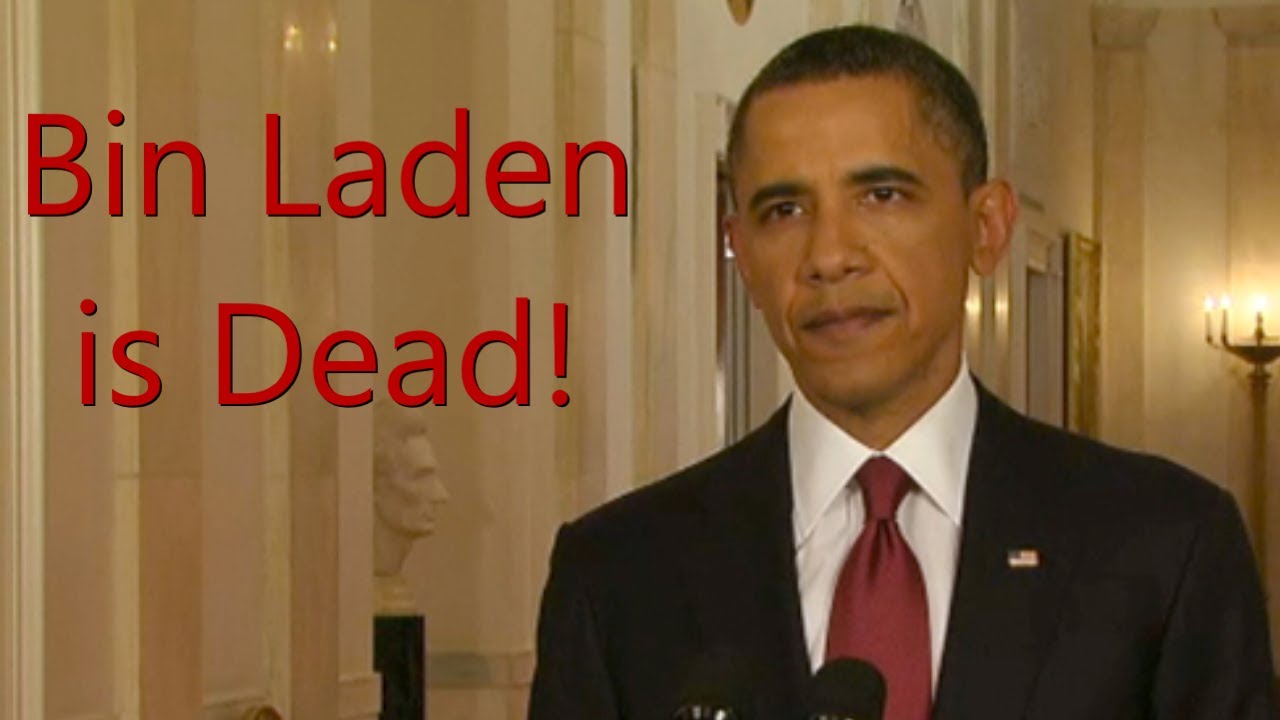
- Obama Announces the Death of Osama bin Laden
Obama Announces the Death of Osama bin Laden
- Madison's Message to Congress on renewed trade with Britain
Fellow-Citizens of the Senate and of the House of Representatives, On this first occasion of meeting you it affords me much satisfaction to be able to communicate the commencement of a favorable change in our foreign relations, the critical state of which induced a session of Congress at this early period. In consequence of the provisions of the act interdicting commercial intercourse with Great Britain and France, our ministers at London and Paris were without delay instructed to let it be understood by the French and British Governments that the authority vested in the Executive to renew commercial intercourse with their respective nations would be exercised in the case specified by that act. Soon after these instructions were dispatched it was found that the British Government, anticipating from early proceedings of Congress at their last session the state of our laws, which has had the effect of placing the two belligerent powers on a footing of equal restrictions, and relying on the conciliatory disposition of the United States, had transmitted to their legation here provisional instructions not only to offer satisfaction for the attack on the frigate Chesapeake, and to make known the determination of His Britannic Majesty to send an Envoy Extraordinary with powers to conclude a treaty on all the points between the two countries, but, moreover, to signify his willingness in the meantime to withdraw his orders in council, in the persuasion that the intercourse with Great Britain would be renewed on the part of the United States. These steps of the British Government led to the correspondence and the proclamation now laid before you; by virtue of which, the commerce between the two countries will be renewable after the tenth day of June next. Whilst I take pleasure in doing justice to the councils of His Britannic Majesty, which, no longer adhering to the policy which made an abandonment by France of her decrees a prerequisite to a revocation of the British orders, have substituted the amicable course which has issued thus happily, I cannot do less than refer to the proposal heretofore made on the part of the United States, embracing a like restoration of the suspended commerce, as a proof of the spirit of accommodation which has at no time been intermitted, and to the result which now calls for our congratulations, as corroborating the principles by which the public councils have been guided during a period of the most trying embarrassments. The discontinuance of the British orders as they respect the United States having been thus arranged, a communication of the event has been forwarded in one of our public vessels to our minister plenipotentiary at Paris, with instructions to avail himself of the important addition thereby made to the considerations which press on the justice of the French Government a revocation of its decrees or such a modification of them as that they shall cease to violate the neutral commerce of the United States. The revision of our commercial laws proper to adapt them to the arrangement which has taken place with Great Britain will doubtless engage the early attention of Congress. It will be worthy, at the same time, of their just and provident care to make such further alterations in the laws as will more especially protect and foster the several branches of manufacture which have been recently instituted or extended by the laudable exertions of our citizens. Under the existing aspect of our affairs I have thought it not inconsistent with a just precaution to have the gunboats, with the exception of those at New Orleans, placed in a situation incurring no expense beyond that requisite for their preservation and conveniency for future service, and to have the crews of those at New Orleans reduced to the number required for their navigation and safety. I have thought also, that our citizens detached in quotas of militia amounting to one hundred thousand under the act of March, 1808, might not improperly be relieved from the state in which they were held for immediate service. A discharge of them has been accordingly directed. The progress made in raising and organizing the additional military force, for which provision was made by the act of April 1808, together with the disposition of the troops, will appear by a report which the Secretary of War is preparing, and which will be laid before you. Of the additional frigates required by an act of the last session to be fitted for actual service, two are in readiness, one nearly so, and the fourth is expected to be ready in the month of July. A report which the Secretary of the Navy is preparing on the subject, to be laid before Congress, will shew at the same time the progress made in officering and manning these ships. It will shew also the degree in which the provisions of the act relating to the other public armed ships have been carried into execution. It will rest with the judgment of Congress to decide how far the change in our external prospects may authorize any modifications of the laws relating to the army and navy establishments. The works of defense for our seaport towns and harbors have proceeded with as much activity as the season of the year and other circumstances would admit. It is necessary, however, to state that, the appropriations hitherto made being found to be deficient, a further provision will claim the early consideration of Congress. The whole of the eight per cent. stock remaining due by the United States, amounting to five millions three hundred thousand dollars, had been reimbursed on the last day of the year 1808. And on the first day of April last the sum in the Treasury exceeded nine and a half millions of dollars. This, together with the receipts of the current year on account of former revenue bonds, will probably be nearly if not altogether sufficient to defray the expenses of the year. But the suspension of exports and the consequent decrease of importations during the last twelve months will necessarily cause a great diminution in the receipts of the year 1810. After that year, should our foreign relations be undisturbed, the revenue will again be more than commensurate to all the expenditures. Aware of the inconveniences of a protracted session at the present season of the year, I forbear to call the attention of the Legislature to any matters not particularly urgent. It remains, therefore, only to assure you of the fidelity and alacrity with which I shall cooperate for the welfare and happiness of our country, and to pray that it may experience a continuance of the divine blessings by which it has been so signally favored. JAMES MADISON. May 23, 1809. Source: https://www.sethkaller.com/item/2287-30051.005-Madison%E2%80%99s-Optimistic-First-Message-to-Congress:-A-Prelude-to-the-War-of-1812
- Jefferson Davis' Farewell Address to the Senate
Jefferson Davis' Farewell Address Senate Chamber, U.S. Capitol, January 21, 1861 I rise, Mr. President [John C. Breckinridge], for the purpose of announcing to the Senate that I have satisfactory evidence that the State of Mississippi, by a solemn ordinance of her people in convention assembled, has declared her separation from the United States. Under these circumstances, of course my functions are terminated here. It has seemed to me proper, however, that I should appear in the Senate to announce that fact to my associates, and I will say but very little more. The occasion does not invite me to go into argument; and my physical condition would not permit me to do so if it were otherwise; and yet it seems to become me to say something on the part of the State I here represent, on an occasion so solemn as this. It is known to Senators who have served with me here, that I have for many years advocated, as an essential attribute of State sovereignty, the right of a State to secede from the Union. Therefore, if I had not believed there was justifiable cause; if I had thought that Mississippi was acting without sufficient provocation, or without an existing necessity, I should still, under my theory of the Government, because of my allegiance to the State of which I am a citizen, have been bound by her action. I, however, may be permitted to say that I do think she has justifiable cause, and I approve of her act. I conferred with her people before that act was taken, counseled them then that if the state of things which they apprehended should exist when the convention met, they should take the action which they have now adopted. I hope none who hear me will confound this expression of mine with the advocacy of the right of a State to remain in the Union, and to disregard its constitutional obligations by the nullification of the law. Such is not my theory. Nullification and secession, so often confounded, are indeed antagonistic principles. Nullification is a remedy which it is sought to apply within the Union, and against the agent of the States. It is only to be justified when the agent has violated his constitutional obligation, and a State, assuming to judge for itself, denies the right of the agent thus to act, and appeals to the other States of the Union for a decision; but when the States themselves, and when the people of the States, have so acted as to convince us that they will not regard our constitutional rights, then, and then for the first time, arises the doctrine of secession in its practical application. A great man who now reposes with his fathers, and who has been often arraigned for a want of fealty to the Union, advocated the doctrine of nullification, because it preserved the Union. It was because of his deep-seated attachment to the Union, his determination to find some remedy for existing ills short of a severance of the ties which bound South Carolina to the other States, that Mr. [John C.] Calhoun advocated the doctrine of nullification, which he proclaimed to be peaceful, to be within the limits of State power, not to disturb the Union, but only to be a means of bringing the agent before the tribunal of the States for their judgment. Secession belongs to a different class of remedies. It is to be justified upon the basis that the States are sovereign. There was a time when none denied it. I hope the time may come again, when a better comprehension of the theory of our Government, and the inalienable rights of the people of the States, will prevent any one from denying that each State is a sovereign, and thus may reclaim the grants which it has made to any agent whomsoever. I therefore say I concur in the action of the people of Mississippi, believing it to be necessary and proper, and should have been bound by their action if my belief had been otherwise; and this brings me to the important point which I wish on this last occasion to present to the Senate. It is by this confounding of nullification and secession that the name of a great man, whose ashes now mingle with his mother earth, has been invoked to justify coercion against a seceded State. The phrase "to execute the laws," was an expression which General Jackson applied to the case of a State refusing to obey the laws while yet a member of the Union. That is not the case which is now presented. The laws are to be executed over the United States, and upon the people of the United States. They have no relation to any foreign country. It is a perversion of terms, at least it is a great misapprehension of the case, which cites that expression for application to a State which has withdrawn from the Union. You may make war on a foreign State. If it be the purpose of gentlemen, they may make war against a State which has withdrawn from the Union; but there are no laws of the United States to be executed within the limits of a seceded State. A State finding herself in the condition in which Mississippi has judged she is, in which her safety requires that she should provide for the maintenance of her rights out of the Union, surrenders all the benefits, (and they are known to be many,) deprives herself of the advantages, (they are known to be great,) severs all the ties of affection, (and they are close and enduring,) which have bound her to the Union; and thus divesting herself of every benefit, taking upon herself every burden, she claims to be exempt from any power to execute the laws of the United States within her limits. I well remember an occasion when Massachusetts was arraigned before the bar of the Senate, and when then the doctrine of coercion was rife and to be applied against her because of the rescue of a fugitive slave in Boston. My opinion then was the same that it is now. Not in a spirit of egotism, but to show that I am not influenced in my opinion because the case is my own, I refer to that time and that occasion as containing the opinion which I then entertained, and on which my present conduct is based. I then said, if Massachusetts, following her through a stated line of conduct, chooses to take the last step which separates her from the Union, it is her right to go, and I will neither vote one dollar nor one man to coerce her back; but will say to her, God speed, in memory of the kind associations which once existed between her and the other States. It has been a conviction of pressing necessity, it has been a belief that we are to be deprived in the Union of the rights which our fathers bequeathed to us, which has brought Mississippi into her present decision. She has heard proclaimed the theory that all men are created free and equal, and this made the basis of an attack upon her social institutions; and the sacred Declaration of Independence has been invoked to maintain the position of the equality of the races. That Declaration of Independence is to be construed by the circumstances and purposes for which it was made. The communities were declaring their independence; the people of those communities were asserting that no man was born--to use the language of Mr. Jefferson--booted and spurred to ride over the rest of mankind; that men were created equal--meaning the men of the political community; that there was no divine right to rule; that no man inherited the right to govern; that there were no classes by which power and place descended to families, but that all stations were equally within the grasp of each member of the body-politic. These were the great principles they announced; these were the purposes for which they made their declaration; these were the ends to which their enunciation was directed. They have no reference to the slave; else, how happened it that among the items of arraignment made against George III was that he endeavored to do just what the North has been endeavoring of late to do--to stir up insurrection among our slaves? Had the Declaration announced that the negroes were free and equal, how was the Prince to be arraigned for stirring up insurrection among them? And how was this to be enumerated among the high crimes which caused the colonies to sever their connection with the mother country? When our Constitution was formed, the same idea was rendered more palpable, for there we find provision made for that very class of persons as property; they were not put upon the footing of equality with white men--not even upon that of paupers and convicts; but, so far as representation was concerned, were discriminated against as a lower caste, only to be represented in the numerical proportion of three fifths. Then, Senators, we recur to the compact which binds us together; we recur to the principles upon which our Government was founded; and when you deny them, and when you deny to us the right to withdraw from a Government which thus perverted threatens to be destructive of our rights, we but tread in the path of our fathers when we proclaim our independence, and take the hazard. This is done not in hostility to others, not to injure any section of the country, not even for our own pecuniary benefit; but from the high and solemn motive of defending and protecting the rights we inherited, and which it is our sacred duty to transmit unshorn to our children. I find in myself, perhaps, a type of the general feeling of my constituents towards yours. I am sure I feel no hostility to you, Senators from the North. I am sure there is not one of you, whatever sharp discussion there may have been between us, to whom I cannot now say, in the presence of my God, I wish you well; and such, I am sure, is the feeling of the people whom I represent towards those whom you represent. I therefore feel that I but express their desire when I say I hope, and they hope, for peaceful relations with you, though we must part. They may be mutually beneficial to us in the future, as they have been in the past, if you so will it. The reverse may bring disaster on every portion of the country; and if you will have it thus, we will invoke the God of our fathers, who delivered them from the power of the lion, to protect us from the ravages of the bear; and thus, putting our trust in God and in our own firm hearts and strong arms, we will vindicate the right as best we may. In the course of my service here, associated at different times with a great variety of Senators, I see now around me some with whom I have served long; there have been points of collision; but whatever of offense there has been to me, I leave here; I carry with me no hostile remembrance. Whatever offense I have given which has not been redressed, or for which satisfaction has not been demanded, I have, Senators, in this hour of our parting, to offer you my apology for any pain which, in heat of discussion, I have inflicted. I go hence unencumbered of the remembrance of any injury received, and having discharged the duty of making the only reparation in my power for any injury offered. Mr. President, and Senators, having made the announcement which the occasion seemed to me to require, it only remains to me to bid you a final adieu. Source: The Papers of Jefferson Davis , Volume 7, pp. 18-23. Transcribed from the Congressional Globe , 36th Congress, 2d Session, p. 487.
- Congress Proclaims the Cessation of Arms
By the UNITED STATES of America In Congress Assembled. A PROCLAMATION, Declaring the Cessation of Arms, as well by Sea as by Land, agreed upon between the United States of America and His Britannic Majesty; and enjoining the Observance thereof. Whereas Provisional Articles were signed at Paris on the Thirtieth Day of November last, between the Ministers Plenipotentiary of the United States of America for treating of Peace, and the Minister Plenipotentiary of His Britannic Majesty, to be inserted in and to constitute the Treaty of Peace proposed to be concluded between the United States of America and his Britannic Majesty, when Terms of Peace should be agreed upon between their Most Christian and Britannic Majesties: And Whereas Preliminaries for restoring Peace between their Most Christian and Britannic Majesties were signed at Versailles, on the Twentieth Day of January last, by the Ministers of their Most Christian and Britannic Majesties: And Whereas Preliminaries for restoring Peace between the said King of Great Britain and the King of Spain were also signed at Versailles, on the same Twentieth Day of January last. By which said Preliminary Articles it hath been agreed, That as soon as the same were ratified, Hostilities between the said Kings, their Kingdoms, States and Subjects, should Cease in all Parts of the World; and it was farther agreed That all Vessels and Effects that might be taken in the Channel and in the North Seas, after the Space of Twelve Days from the Ratification of the said Preliminary Articles, should be restored; that the Term should be One Month from the Channel and North Seas as far as the Canary Islands inclusively, whether in the Ocean or the Mediterranean, Two Months from the said Canary Islands as far as the Equinoctial Line or Equator; and lastly, Five Months in all other Parts of the World, without any Exception or more particular Description of time or Place: And Whereas it was Declared by the Minister Plenipotentiary of the King of Great Britain, in the Name and by the express Order of the King his Master, on the said Twentieth day of January last, that the said United States of America, their Subjects and their Possessions shall be comprised in the above mentioned Suspension of Arms, at the same Epochs, and in the same manner, as the three Crowns above mentioned, their Subjects and Possessions respectively; upon Condition that on the Part, and in the Name of the United States of America, a similar Declaration shall be Delivered, expressly Declaring their Assent to the said Suspension of Arms, and containing an Assurance of the most perfect Reciprocity on their Part: And Whereas the Ministers Plenipotentiary of these United States, did, on the same Twentieth Day of January, in the Name and by the Authority of the said United States, accept the said Declaration, and declare, that the said States should cause all Hostilities to Cease against His Britannic Majesty, his Subjects and his Possessions, at the Terms and Epochs agreed upon between His said Majesty the King of Great-Britain, His Majesty the King of France, and His Majesty the King of Spain, so, and in the same Manner, as had been agreed upon between those Three Crowns, and to produce the same Effects: And Whereas the Ratifications of the said Preliminary Articles their Most Christian and Britannic Majesties were exchanged by their Ministers on the Third Day of February last, and between His Britannic Majesty and the King of Spain on the Ninth Day of February last: And Whereas it is Our Will and Pleasure that the Cessation of Hostilities between the United States of America and his Britannic Majesty, should be conformable to the Epochs fixed between their Most Christian and Britannic Majesties. We have thought fit to make known the same to the Citizens of these States, and we hereby strictly Charge and Command all our Officers, both by Sea and Land, and others, Subjects of these United States, to Forbear all Acts of Hostility, either by Sea or by Land, against His Britannic Majesty or his Subjects, from and after the respective Times agreed upon between their Most Christian and Britannic Majesties as aforesaid. And We do further require all Governors and others, the Executive Powers of these United States respectively, to cause this our Proclamation to be made Public, to the end that the same be duly observed within their several Jurisdictions. Done in Congress, at Philadelphia, this Eleventh Day of April, in the Year of our Lord One Thousand Seven Hundred and Eighty-Three, and of our Sovereignty and Independence the Seventh. Attest CHA THOMSON Secy ELIAS BOUDINOT Presid Source: https://avalon.law.yale.edu/18th_century/pre782n.asp?utm_source=chatgpt.com
- The American Crisis: Number I, by Thomas Paine
The American Crisis Number I Thomas Paine December 19, 1776 THESE are the times that try men's souls. The summer soldier and the sunshine patriot will, in this crisis, shrink from the service of their country; but he that stands by it now, deserves the love and thanks of man and woman. Tyranny, like hell, is not easily conquered; yet we have this consolation with us, that the harder the conflict, the more glorious the triumph. What we obtain too cheap, we esteem too lightly: it is dearness only that gives every thing its value. Heaven knows how to put a proper price upon its goods; and it would be strange indeed if so celestial an article as FREEDOM should not be highly rated. Britain, with an army to enforce her tyranny, has declared that she has a right (not only to TAX) but "to BIND us in ALL CASES WHATSOEVER" and if being bound in that manner, is not slavery, then is there not such a thing as slavery upon earth. Even the expression is impious; for so unlimited a power can belong only to God. Whether the independence of the continent was declared too soon, or delayed too long, I will not now enter into as an argument; my own simple opinion is, that had it been eight months earlier, it would have been much better. We did not make a proper use of last winter, neither could we, while we were in a dependent state. However, the fault, if it were one, was all our own; we have none to blame but ourselves. But no great deal is lost yet. All that Howe has been doing for this month past, is rather a ravage than a conquest, which the spirit of the Jerseys, a year ago, would have quickly repulsed, and which time and a little resolution will soon recover. I have as little superstition in me as any man living, but my secret opinion has ever been, and still is, that God Almighty will not give up a people to military destruction, or leave them unsupportedly to perish, who have so earnestly and so repeatedly sought to avoid the calamities of war, by every decent method which wisdom could invent. Neither have I so much of the infidel in me, as to suppose that He has relinquished the government of the world, and given us up to the care of devils; and as I do not, I cannot see on what grounds the king of Britain can look up to heaven for help against us: a common murderer, a highwayman, or a house-breaker, has as good a pretence as he. 'Tis surprising to see how rapidly a panic will sometimes run through a country. All nations and ages have been subject to them. Britain has trembled like an ague at the report of a French fleet of flat-bottomed boats; and in the fourteenth [fifteenth] century the whole English army, after ravaging the kingdom of France, was driven back like men petrified with fear; and this brave exploit was performed by a few broken forces collected and headed by a woman, Joan of Arc. Would that heaven might inspire some Jersey maid to spirit up her countrymen, and save her fair fellow sufferers from ravage and ravishment! Yet panics, in some cases, have their uses; they produce as much good as hurt. Their duration is always short; the mind soon grows through them, and acquires a firmer habit than before. But their peculiar advantage is, that they are the touchstones of sincerity and hypocrisy, and bring things and men to light, which might otherwise have lain forever undiscovered. In fact, they have the same effect on secret traitors, which an imaginary apparition would have upon a private murderer. They sift out the hidden thoughts of man, and hold them up in public to the world. Many a disguised Tory has lately shown his head, that shall penitentially solemnize with curses the day on which Howe arrived upon the Delaware. As I was with the troops at Fort Lee, and marched with them to the edge of Pennsylvania, I am well acquainted with many circumstances, which those who live at a distance know but little or nothing of. Our situation there was exceedingly cramped, the place being a narrow neck of land between the North River and the Hackensack. Our force was inconsiderable, being not one-fourth so great as Howe could bring against us. We had no army at hand to have relieved the garrison, had we shut ourselves up and stood on our defence. Our ammunition, light artillery, and the best part of our stores, had been removed, on the apprehension that Howe would endeavor to penetrate the Jerseys, in which case Fort Lee could be of no use to us; for it must occur to every thinking man, whether in the army or not, that these kind of field forts are only for temporary purposes, and last in use no longer than the enemy directs his force against the particular object which such forts are raised to defend. Such was our situation and condition at Fort Lee on the morning of the 20th of November, when an officer arrived with information that the enemy with 200 boats had landed about seven miles above; Major General [Nathaniel] Green, who commanded the garrison, immediately ordered them under arms, and sent express to General Washington at the town of Hackensack, distant by the way of the ferry = six miles. Our first object was to secure the bridge over the Hackensack, which laid up the river between the enemy and us, about six miles from us, and three from them. General Washington arrived in about three-quarters of an hour, and marched at the head of the troops towards the bridge, which place I expected we should have a brush for; however, they did not choose to dispute it with us, and the greatest part of our troops went over the bridge, the rest over the ferry, except some which passed at a mill on a small creek, between the bridge and the ferry, and made their way through some marshy grounds up to the town of Hackensack, and there passed the river. We brought off as much baggage as the wagons could contain, the rest was lost. The simple object was to bring off the garrison, and march them on till they could be strengthened by the Jersey or Pennsylvania militia, so as to be enabled to make a stand. We staid four days at Newark, collected our out-posts with some of the Jersey militia, and marched out twice to meet the enemy, on being informed that they were advancing, though our numbers were greatly inferior to theirs. Howe, in my little opinion, committed a great error in generalship in not throwing a body of forces off from Staten Island through Amboy, by which means he might have seized all our stores at Brunswick, and intercepted our march into Pennsylvania; but if we believe the power of hell to be limited, we must likewise believe that their agents are under some providential control. I shall not now attempt to give all the particulars of our retreat to the Delaware; suffice it for the present to say, that both officers and men, though greatly harassed and fatigued, frequently without rest, covering, or provision, the inevitable consequences of a long retreat, bore it with a manly and martial spirit. All their wishes centred in one, which was, that the country would turn out and help them to drive the enemy back. Voltaire has remarked that King William never appeared to full advantage but in difficulties and in action; the same remark may be made on General Washington, for the character fits him. There is a natural firmness in some minds which cannot be unlocked by trifles, but which, when unlocked, discovers a cabinet of fortitude; and I reckon it among those kind of public blessings, which we do not immediately see, that God hath blessed him with uninterrupted health, and given him a mind that can even flourish upon care. I shall conclude this paper with some miscellaneous remarks on the state of our affairs; and shall begin with asking the following question, Why is it that the enemy have left the New England provinces, and made these middle ones the seat of war? The answer is easy: New England is not infested with Tories, and we are. I have been tender in raising the cry against these men, and used numberless arguments to show them their danger, but it will not do to sacrifice a world either to their folly or their baseness. The period is now arrived, in which either they or we must change our sentiments, or one or both must fall. And what is a Tory? Good God! What is he? I should not be afraid to go with a hundred Whigs against a thousand Tories, were they to attempt to get into arms. Every Tory is a coward; for servile, slavish, self-interested fear is the foundation of Toryism; and a man under such influence, though he may be cruel, never can be brave. But, before the line of irrecoverable separation be drawn between us, let us reason the matter together: Your conduct is an invitation to the enemy, yet not one in a thousand of you has heart enough to join him. Howe is as much deceived by you as the American cause is injured by you. He expects you will all take up arms, and flock to his standard, with muskets on your shoulders. Your opinions are of no use to him, unless you support him personally, for 'tis soldiers, and not Tories, that he wants. I once felt all that kind of anger, which a man ought to feel, against the mean principles that are held by the Tories: a noted one, who kept a tavern at Amboy, was standing at his door, with as pretty a child in his hand, about eight or nine years old, as I ever saw, and after speaking his mind as freely as he thought was prudent, finished with this unfatherly expression, "Well! give me peace in my day." Not a man lives on the continent but fully believes that a separation must some time or other finally take place, and a generous parent should have said, "If there must be trouble, let it be in my day, that my child may have peace;" and this single reflection, well applied, is sufficient to awaken every man to duty. Not a place upon earth might be so happy as America. Her situation is remote from all the wrangling world, and she has nothing to do but to trade with them. A man can distinguish himself between temper and principle, and I am as confident, as I am that God governs the world, that America will never be happy till she gets clear of foreign dominion. Wars, without ceasing, will break out till that period arrives, and the continent must in the end be conqueror; for though the flame of liberty may sometimes cease to shine, the coal can never expire. America did not, nor does not want force; but she wanted a proper application of that force. Wisdom is not the purchase of a day, and it is no wonder that we should err at the first setting off. From an excess of tenderness, we were unwilling to raise an army, and trusted our cause to the temporary defence of a well-meaning militia. A summer's experience has now taught us better; yet with those troops, while they were collected, we were able to set bounds to the progress of the enemy, and, thank God! they are again assembling. I always considered militia as the best troops in the world for a sudden exertion, but they will not do for a long campaign. Howe, it is probable, will make an attempt on this city [Philadelphia]; should he fail on this side the Delaware, he is ruined. If he succeeds, our cause is not ruined. He stakes all on his side against a part on ours; admitting he succeeds, the consequence will be, that armies from both ends of the continent will march to assist their suffering friends in the middle states; for he cannot go everywhere, it is impossible. I consider Howe as the greatest enemy the Tories have; he is bringing a war into their country, which, had it not been for him and partly for themselves, they had been clear of. Should he now be expelled, I wish with all the devotion of a Christian, that the names of Whig and Tory may never more be mentioned; but should the Tories give him encouragement to come, or assistance if he come, I as sincerely wish that our next year's arms may expel them from the continent, and the Congress appropriate their possessions to the relief of those who have suffered in well-doing. A single successful battle next year will settle the whole. America could carry on a two years' war by the confiscation of the property of disaffected persons, and be made happy by their expulsion. Say not that this is revenge, call it rather the soft resentment of a suffering people, who, having no object in view but the good of all, have staked their own all upon a seemingly doubtful event. Yet it is folly to argue against determined hardness; eloquence may strike the ear, and the language of sorrow draw forth the tear of compassion, but nothing can reach the heart that is steeled with prejudice. Quitting this class of men, I turn with the warm ardor of a friend to those who have nobly stood, and are yet determined to stand the matter out: I call not upon a few, but upon all: not on this state or that state, but on every state: up and help us; lay your shoulders to the wheel; better have too much force than too little, when so great an object is at stake. Let it be told to the future world, that in the depth of winter, when nothing but hope and virtue could survive, that the city and the country, alarmed at one common danger, came forth to meet and to repulse it. Say not that thousands are gone, turn out your tens of thousands; throw not the burden of the day upon Providence, but "show your faith by your works," that God may bless you. It matters not where you live, or what rank of life you hold, the evil or the blessing will reach you all. The far and the near, the home counties and the back, the rich and the poor, will suffer or rejoice alike. The heart that feels not now is dead; the blood of his children will curse his cowardice, who shrinks back at a time when a little might have saved the whole, and made them happy. I love the man that can smile in trouble, that can gather strength from distress, and grow brave by reflection. 'Tis the business of little minds to shrink; but he whose heart is firm, and whose conscience approves his conduct, will pursue his principles unto death. My own line of reasoning is to myself as straight and clear as a ray of light. Not all the treasures of the world, so far as I believe, could have induced me to support an offensive war, for I think it murder; but if a thief breaks into my house, burns and destroys my property, and kills or threatens to kill me, or those that are in it, and to "bind me in all cases whatsoever" to his absolute will, am I to suffer it? What signifies it to me, whether he who does it is a king or a common man; my countryman or not my countryman; whether it be done by an individual villain, or an army of them? If we reason to the root of things we shall find no difference; neither can any just cause be assigned why we should punish in the one case and pardon in the other. Let them call me rebel and welcome, I feel no concern from it; but I should suffer the misery of devils, were I to make a whore of my soul by swearing allegiance to one whose character is that of a sottish, stupid, stubborn, worthless, brutish man. I conceive likewise a horrid idea in receiving mercy from a being, who at the last day shall be shrieking to the rocks and mountains to cover him, and fleeing with terror from the orphan, the widow, and the slain of America. There are cases which cannot be overdone by language, and this is one. There are persons, too, who see not the full extent of the evil which threatens them; they solace themselves with hopes that the enemy, if he succeed, will be merciful. It is the madness of folly, to expect mercy from those who have refused to do justice; and even mercy, where conquest is the object, is only a trick of war; the cunning of the fox is as murderous as the violence of the wolf, and we ought to guard equally against both. Howe's first object is, partly by threats and partly by promises, to terrify or seduce the people to deliver up their arms and receive mercy. The ministry recommended the same plan to Gage, and this is what the tories call making their peace, "a peace which passeth all understanding" indeed! A peace which would be the immediate forerunner of a worse ruin than any we have yet thought of. Ye men of Pennsylvania, do reason upon these things! Were the back counties to give up their arms, they would fall an easy prey to the Indians, who are all armed: this perhaps is what some Tories would not be sorry for. Were the home counties to deliver up their arms, they would be exposed to the resentment of the back counties who would then have it in their power to chastise their defection at pleasure. And were any one state to give up its arms, that state must be garrisoned by all Howe's army of Britons and Hessians to preserve it from the anger of the rest. Mutual fear is the principal link in the chain of mutual love, and woe be to that state that breaks the compact. Howe is mercifully inviting you to barbarous destruction, and men must be either rogues or fools that will not see it. I dwell not upon the vapors of imagination; I bring reason to your ears, and, in language as plain as A, B, C, hold up truth to your eyes. I thank God, that I fear not. I see no real cause for fear. I know our situation well, and can see the way out of it. While our army was collected, Howe dared not risk a battle; and it is no credit to him that he decamped from the White Plains, and waited a mean opportunity to ravage the defenceless Jerseys; but it is great credit to us, that, with a handful of men, we sustained an orderly retreat for near an hundred miles, brought off our ammunition, all our field pieces, the greatest part of our stores, and had four rivers to pass. None can say that our retreat was precipitate, for we were near three weeks in performing it, that the country might have time to come in. Twice we marched back to meet the enemy, and remained out till dark. The sign of fear was not seen in our camp, and had not some of the cowardly and disaffected inhabitants spread false alarms through the country, the Jerseys had never been ravaged. Once more we are again collected and collecting; our new army at both ends of the continent is recruiting fast, and we shall be able to open the next campaign with sixty thousand men, well armed and clothed. This is our situation, and who will may know it. By perseverance and fortitude we have the prospect of a glorious issue; by cowardice and submission, the sad choice of a variety of evils - a ravaged country - a depopulated city - habitations without safety, and slavery without hope - our homes turned into barracks and bawdy-houses for Hessians, and a future race to provide for, whose fathers we shall doubt of. Look on this picture and weep over it! and if there yet remains one thoughtless wretch who believes it not, let him suffer it unlamented. Source: https://www.ushistory.org/paine/crisis/c-01.htm
- Rules By Which A Great Empire May Be Reduced To A Small One
Rules By Which A Great Empire May Be Reduced To A Small One By Benjamin Franklin September 11, 1773 An ancient Sage valued himself upon this, that tho' he could not fiddle, he knew how to make a great City of a little one. The Science that I, a modern Simpleton, am about to communicate is the very reverse. I address myself to all Ministers who have the Management of extensive Dominions, which from their very Greatness are become troublesome to govern, because the Multiplicity of their Affairs leaves no Time for fiddling. 1. In the first Place, Gentlemen, you are to consider, that a great Empire, like a great Cake, is most easily diminished at the Edges. Turn your Attention therefore first to your remotest Provinces; that as you get rid of them, the next may follow in Order. 2. That the Possibility of this Separation may always exist, take special Care the Provinces are never incorporated with the Mother Country, that they do not enjoy the same common Rights, the same Privileges in Commerce, and that they are governed by severer Laws, all of your enacting, without allowing them any Share in the Choice of the Legislators. By carefully making and preserving such Distinctions, you will (to keep to my Simile of the Cake) act like a wise Gingerbread Baker, who, to facilitate a Division, cuts his Dough half through in those Places, where, when bak'd, he would have it broken to Pieces. 3. These remote Provinces have perhaps been acquired, purchas'd, or conquer'd, at the sole Expence of the Settlers or their Ancestors, without the Aid of the Mother Country. If this should happen to increase her Strength by their growing Numbers ready to join in her Wars, her Commerce by their growing Demand for her Manufactures, or her Naval Power by greater Employment for her Ships and Seamen, they may probably suppose some Merit in this, and that it entitles them to some Favour; you are therefore to forget it all, or resent it as if they had done you Injury. If they happen to be zealous Whigs, Friends of Liberty, nurtur'd in Revolution Principles, remember all that to their Prejudice, and contrive to punish it: For such Principles, after a Revolution is thoroughly established, are of no more Use, they are even odious and abominable. 4. However peaceably your Colonies have submitted to your Government, shewn their Affection to your Interest, and patiently borne their Grievances, you are to suppose them always inclined to revolt, and treat them accordingly. Quarter Troops among them, who by their Insolence may provoke the rising of Mobs, and by their Bullets and Bayonets suppress them. By this Means, like the Husband who uses his Wife ill from Suspicion, you may in Time convert your Suspicions into Realities. 5. Remote Provinces must have Governors, and Judges, to represent the Royal Person, and execute every where the delegated Parts of his Office and Authority. You Ministers know, that much of the Strength of Government depends on the Opinion of the People; and much of that Opinion on the Choice of Rulers placed immediately over them. If you send them wise and good Men for Governors, who study the Interest of the Colonists, and advance their Prosperity, they will think their King wise and good, and that he wishes the Welfare of his Subjects. If you send them learned and upright Men for Judges, they will think him a Lover of Justice. This may attach your Provinces more to his Government. You are therefore to be careful who you recommend for those Offices. -- If you can find Prodigals who have ruined their Fortunes, broken Gamesters or Stock-Jobbers, these may do well as Governors; for they will probably be rapacious, and provoke the People by their Extortions. Wrangling Proctors and petty-fogging Lawyers too are not amiss, for they will be for ever disputing and quarrelling with their little Parliaments. If withal they should be ignorant, wrong-headed and insolent, so much the better. Attorneys Clerks and Newgate Solicitors will do for Chief-Justices, especially if they hold their Places during your Pleasure: -- And all will contribute to impress those ideas of your Government that are proper for a People you would wish to renounce it. 6. To confirm these Impressions, and strike them deeper, whenever the Injured come to the Capital with Complaints of Mal-administration, Oppression, or Injustice, punish such Suitors with long Delay, enormous Expence, and a final Judgment in Favour of the Oppressor. This will have an admirable Effect every Way. The Trouble of future Complaints will be prevented, and Governors and Judges will be encouraged to farther Acts of Oppression and Injustice; and thence the People may become more disaffected, and at length desperate. 7. When such Governors have crammed their Coffers, and made themselves so odious to the People that they can no longer remain among them with Safety to their Persons, recall and reward them with Pensions. You may make them Baronets too, if that respectable Order should not think fit to resent it. All will contribute to encourage new Governors in the same Practices, and make the supreme Government detestable. 8. If when you are engaged in War, your Colonies should vie in liberal Aids of Men and Money against the common Enemy, upon your simple Requisition, and give far beyond their Abilities, reflect, that a Penny taken from them by your Power is more honourable to you than a Pound presented by their Benevolence. Despise therefore their voluntary Grants, and resolve to harrass them with novel Taxes. They will probably complain to your Parliaments that they are taxed by a Body in which they have no Representative, and that this is contrary to common Right. They will petition for Redress. Let the Parliaments flout their Claims, reject their Petitions, refuse even to suffer the reading of them, and treat the Petitioners with the utmost Contempt. Nothing can have a better Effect, in producing the Alienation proposed; for though many can forgive Injuries, none ever forgave Contempt. 9. In laying these Taxes, never regard the heavy Burthens those remote People already undergo, in defending their own Frontiers, supporting their own provincial Governments, making new Roads, building Bridges, Churches and other public Edifices, which in old Countries have been done to your Hands by your Ancestors, but which occasion constant Calls and Demands on the Purses of a new People. Forget the Restraints you lay on their Trade for your own Benefit, and the Advantage a Monopoly of this Trade gives your exacting Merchants. Think nothing of the Wealth those Merchants and your Manufacturers acquire by the Colony Commerce; their encreased Ability thereby to pay Taxes at home; their accumulating, in the Price of their Commodities, most of those Taxes, and so levying them from their consuming Customers: All this, and the Employment and Support of Thousands of your Poor by the Colonists, you are intirely to forget. But remember to make your arbitrary Tax more grievous to your Provinces, by public Declarations importing that your Power of taxing them has no Limits, so that when you take from them without their Consent a Shilling in the Pound, you have a clear Right to the other nineteen. This will probably weaken every Idea of Security in their Property, and convince them that under such a Government they have nothing they can call their own; which can scarce fail of producing the happiest Consequences! 10. Possibly indeed some of them might still comfort themselves, and say, `Though we have no Property, we have yet something left that is valuable; we have constitutional Liberty both of Person and of Conscience. This King, these Lords, and these Commons, who it seems are too remote from us to know us and feel for us, cannot take from us our Habeas Corpus Right, or our Right of Trial by a Jury of our Neighbours: They cannot deprive us of the Exercise of our Religion, alter our ecclesiastical Constitutions, and compel us to be Papists if they please, or Mahometans.' To annihilate this Comfort, begin by Laws to perplex their Commerce with infinite Regulations impossible to be remembered and observed; ordain Seizures of their Property for every Failure; take away the Trial of such Property by Jury, and give it to arbitrary Judges of your own appointing, and of the lowest Characters in the Country, whose Salaries and Emoluments are to arise out of the Duties or Condemnations, and whose Appointments are during Pleasure. Then let there be a formal Declaration of both Houses, that Opposition to your Edicts is Treason, and that Persons suspected of Treason in the Provinces may, according to some obsolete Law, be seized and sent to the Metropolis of the Empire for Trial; and pass an Act that those there charged with certain other Offences shall be sent away in Chains from their Friends and Country to be tried in the same Manner for Felony. Then erect a new Court of Inquisition among them, accompanied by an armed Force, with Instructions to transport all such suspected Persons, to be ruined by the Expence if they bring over Evidences to prove their Innocence, or be found guilty and hanged if they can't afford it. And lest the People should think you cannot possibly go any farther, pass another solemn declaratory Act, that `King, Lords, and Commons had, hath, and of Right ought to have, full Power and Authority to make Statutes of sufficient Force and Validity to bind the unrepresented Provinces IN ALL CASES WHATSOEVER.' This will include spiritual with temporal; and taken together, must operate wonderfully to your Purpose, by convincing them, that they are at present under a Power something like that spoken of in the Scriptures, which can not only kill their Bodies, but damn their Souls to all Eternity, by compelling them, if it pleases, to worship the Devil. 11. To make your Taxes more odious, and more likely to procure Resistance, send from the Capital a Board of Officers to superintend the Collection, composed of the most indiscreet, ill-bred and insolent you can find. Let these have large Salaries out of the extorted Revenue, and live in open grating Luxury upon the Sweat and Blood of the Industrious, whom they are to worry continually with groundless and expensive Prosecutions before the above-mentioned arbitrary Revenue-Judges, all at the Cost of the Party prosecuted tho' acquitted, because the King is to pay no Costs. -- Let these Men by your Order be exempted from all the common Taxes and Burthens of the Province, though they and their Property are protected by its Laws. If any Revenue Officers are suspected of the least Tenderness for the People, discard them. If others are justly complained of, protect and reward them. If any of the Under-officers behave so as to provoke the People to drub them, promote those to better Offices: This will encourage others to procure for themselves such profitable Drubbings, by multiplying and enlarging such Provocations, and all with work towards the End you aim at. 12. Another Way to make your Tax odious, is to misapply the Produce of it. If it was originally appropriated for the Defence of the Provinces and the better Support of Government, and the Administration of Justice where it may be necessary, then apply none of it to that Defence, but bestow it where it is not necessary, in augmented Salaries or Pensions to every Governor who has distinguished himself by his Enmity to the People, and by calumniating them to their Sovereign. This will make them pay it more unwillingly, and be more apt to quarrel with those that collect it, and those that imposed it, who will quarrel again with them, and all shall contribute to your main Purpose of making them weary of your Government. 13. If the People of any Province have been accustomed to support their own Governors and Judges to Satisfaction, you are to apprehend that such Governors and Judges may be thereby influenced to treat the People kindly, and to do them Justice. This is another Reason for applying Part of that Revenue in larger Salaries to such Governors and Judges, given, as their Commissions are, during your Pleasure only, forbidding them to take any Salaries from their Provinces; that thus the People may no longer hope any Kindness from their Governors, or (in Crown Cases) any Justice from their Judges. And as the Money thus mis-applied in one Province is extorted from all, probably all will resent the Mis-application. 14. If the Parliaments of your Provinces should dare to claim Rights or complain of your Administration, order them to be harass'd with repeated Dissolutions. If the same Men are continually return'd by new Elections, adjourn their Meetings to some Country Village where they cannot be accommodated, and there keep them during Pleasure; for this, you know, is your PREROGATIVE; and an excellent one it is, as you may manage it, to promote Discontents among the People, diminish their Respect, and increase their Dis-affection. 15. Convert the brave honest Officers of your Navy into pimping Tide-waiters and Colony Officers of the Customs. Let those who in Time of War fought gallantly in Defence of the Commerce of their Countrymen, in Peace be taught to prey upon it. Let them learn to be corrupted by great and real Smugglers, but (to shew their Diligence) scour with armed Boats every Bay, Harbour, River, Creek, Cove or Nook throughout the Coast of your Colonies, stop and detain every Coaster, every Wood-boat, every Fisherman, tumble their Cargoes, and even their Ballast, inside out and upside down; and if a Penn'orth of Pins is found un-entered, let the Whole be seized and confiscated. Thus shall the Trade of your Colonists suffer more from their Friends in Time of Peace, than it did from their Enemies in War. Then let these Boats Crews land upon every Farm in their Way, rob the Orchards, steal the Pigs and Poultry, and insult the Inhabitants. If the injured and exasperated Farmers, unable to procure other Justice, should attack the Agressors, drub them and burn their Boats, you are to call this High Treason and Rebellion, order Fleets and Armies into their Country, and threaten to carry all the Offenders three thousand Miles to be hang'd, drawn and quartered. O! this will work admirably! 16. If you are told of Discontents in your Colonies, never believe that they are general, or that you have given Occasion for them; therefore do not think of applying any Remedy, or of changing any offensive Measure. Redress no Grievance, lest they should be encouraged to demand the Redress of some other Grievance. Grant no Request that is just and reasonable, lest they should make another that is unreasonable. Take all your Informations of the State of the Colonies from your Governors and Officers in Enmity with them. Encourage and reward these Leasing-makers; secrete their lying Accusations lest they should be confuted; but act upon them as the clearest Evidence, and believe nothing you hear from the Friends of the People. Suppose all their Complaints to be invented and promoted by a few factious Demagogues, whom if you could catch and hang, all would be quiet. Catch and hang a few of them accordingly; and the Blood of the Martyrs shall work Miracles in favour of your Purpose. 17. If you see rival Nations rejoicing at the Prospect of your Disunion with your Provinces, and endeavouring to promote it: If they translate, publish and applaud all the Complaints of your discontented Colonists, at the same Time privately stimulating you to severer Measures; let not that alarm or offend you. Why should it? since you all mean the same Thing. 18. If any Colony should at their own Charge erect a Fortress to secure their Port against the Fleets of a foreign Enemy, get your Governor to betray that Fortress into your Hands. Never think of paying what it cost the Country, for that would look, at least, like some Regard for Justice; but turn it into a Citadel to awe the Inhabitants and curb their Commerce. If they should have lodged in such Fortress the very Arms they bought and used to aid you in your Conquests, seize them all, 'twill provoke like Ingratitude added to Robbery. One admirable Effect of these Operations will be, to discourage every other Colony from erecting such Defences, and so their and your Enemies may more easily invade them, to the great Disgrace of your Government, and of course the Furtherance of your Project. 19. Send Armies into their Country under Pretence of protecting the Inhabitants; but instead of garrisoning the Forts on their Frontiers with those Troops, to prevent Incursions, demolish those Forts, and order the Troops into the Heart of the Country, that the Savages may be encouraged to attack the Frontiers, and that the Troops may be protected by the Inhabitants: This will seem to proceed from your Ill will or your Ignorance, and contribute farther to produce and strengthen an Opinion among them, that you are no longer fit to govern them. 20. Lastly, Invest the General of your Army in the Provinces with great and unconstitutional Powers, and free him from the Controul of even your own Civil Governors. Let him have Troops enow under his Command, with all the Fortresses in his Possession; and who knows but (like some provincial Generals in the Roman Empire, and encouraged by the universal Discontent you have produced) he may take it into his Head to set up for himself. If he should, and you have carefully practised these few excellent Rules of mine, take my Word for it, all the Provinces will immediately join him, and you will that Day (if you have not done it sooner) get rid of the Trouble of governing them, and all the Plagues attending their Commerce and Connection from thenceforth and for ever. Q. E. D. Source: https://en.wikisource.org/wiki/Rules_By_Which_A_Great_Empire_May_Be_Reduced_To_A_Small_One
- Nixon's "Checkers Speech"
My Fellow Americans, I come before you tonight as a candidate for the Vice Presidency and as a man whose honesty and -- and integrity has been questioned. Now, the usual political thing to do when charges are made against you is to either ignore them or to deny them without giving details. I believe we've had enough of that in the United States, particularly with the present Administration in Washington, D.C. To me the office of the Vice Presidency of the United States is a great office, and I feel that the people have got to have confidence in the integrity of the men who run for that office and who might obtain it. I have a theory, too, that the best and only answer to a smear or to an honest misunderstanding of the facts is to tell the truth. And that's why I'm here tonight. I want to tell you my side of the case. I'm sure that you have read the charge, and you've heard it, that I, Senator Nixon, took 18,000 dollars from a group of my supporters. Now, was that wrong? And let me say that it was wrong. I'm saying, incidentally, that it was wrong, not just illegal, because it isn't a question of whether it was legal or illegal, that isn't enough. The question is, was it morally wrong? I say that it was morally wrong -- if any of that 18,000 dollars went to Senator Nixon, for my personal use. I say that it was morally wrong if it was secretly given and secretly handled. And I say that it was morally wrong if any of the contributors got special favors for the contributions that they made. And now to answer those questions let me say this: Not one cent of the 18,000 dollars or any other money of that type ever went to me for my personal use. Every penny of it was used to pay for political expenses that I did not think should be charged to the taxpayers of the United States. It was not a secret fund. As a matter of fact, when I was on "Meet the Press" -- some of you may have seen it last Sunday -- Peter Edson came up to me after the program, and he said, "Dick, what about this "fund" we hear about?" And I said, "Well, there's no secret about it. Go out and see Dana Smith who was the administrator of the fund." And I gave him [Edson] his [Smith's] address. And I said you will find that the purpose of the fund simply was to defray political expenses that I did not feel should be charged to the Government. And third, let me point out -- and I want to make this particularly clear -- that no contributor to this fund, no contributor to any of my campaigns, has ever received any consideration that he would not have received as an ordinary constituent. I just don't believe in that, and I can say that never, while I have been in the Senate of the United States, as far as the people that contributed to this fund are concerned, have I made a telephone call for them to an agency, or have I gone down to an agency in their behalf. And the records will show that, the records which are in the hands of the Administration. Well, then, some of you will say, and rightly, "Well, what did you use the fund for, Senator?" "Why did you have to have it?" Let me tell you in just a word how a Senate office operates. First of all, a Senator gets 15,000 dollars a year in salary. He gets enough money to pay for one trip a year -- a round trip, that is -- for himself and his family between his home and Washington, D.C. And then he gets an allowance to handle the people that work in his office to handle his mail. And the allowance for my State of California is enough to hire 13 people. And let me say, incidentally, that that allowance is not paid to the Senator. It's paid directly to the individuals that the Senator puts on his payroll. But all of these people and all of these allowances are for strictly official business; business, for example, when a constituent writes in and wants you to go down to the Veteran's Administration and get some information about his GI policy -- items of that type, for example. But there are other expenses which are not covered by the Government. And I think I can best discuss those expenses by asking you some questions. Do you think that when I or any other Senator makes a political speech, has it printed, should charge the printing of that speech and the mailing of that speech to the taxpayers? Do you think, for example, when I or any other Senator makes a trip to his home State to make a purely political speech that the cost of that trip should be charged to the taxpayers? Do you think when a Senator makes political broadcasts or political television broadcasts, radio or television, that the expense of those broadcasts should be charged to the taxpayers? Well I know what your answer is. It's the same answer that audiences give me whenever I discuss this particular problem: The answer is no. The taxpayers shouldn't be required to finance items which are not official business but which are primarily political business. Well, then the question arises, you say, "Well, how do you pay for these and how can you do it legally?" And there are several ways that it can be done, incidentally, and that it is done legally in the United States Senate and in the Congress. The first way is to be a rich man. I don't happen to be a rich man, so I couldn't use that one. Another way that is used is to put your wife on the payroll. Let me say, incidentally, that my opponent, my opposite number for the Vice Presidency on the Democratic ticket, does have his wife on the payroll and has had it -- her on his payroll for the ten years -- for the past ten years. Now just let me say this: That's his business, and I'm not critical of him for doing that. You will have to pass judgment on that particular point. But I have never done that for this reason: I have found that there are so many deserving stenographers and secretaries in Washington that needed the work that I just didn't feel it was right to put my wife on the payroll. My wife's sitting over here. She's a wonderful stenographer. She used to teach stenography and she used to teach shorthand in high school. That was when I met her. And I can tell you folks that she's worked many hours at night and many hours on Saturdays and Sundays in my office, and she's done a fine job, and I am proud to say tonight that in the six years I've been in the House and the Senate of the United States, Pat Nixon has never been on the Government payroll. What are other ways that these finances can be taken care of? Some who are lawyers, and I happen to be a lawyer, continue to practice law, but I haven't been able to do that. I'm so far away from California that I've been so busy with my senatorial work that I have not engaged in any legal practice. And, also, as far as law practice is concerned, it seemed to me that the relationship between an attorney and the client was so personal that you couldn't possibly represent a man as an attorney and then have an unbiased view when he presented his case to you in the event that he had one before Government. And so I felt that the best way to handle these necessary political expenses of getting my message to the American people and the speeches I made -- the speeches that I had printed for the most part concerned this one message of exposing this Administration, the Communism in it, the corruption in it -- the only way that I could do that was to accept the aid which people in my home State of California, who contributed to my campaign and who continued to make these contributions after I was elected, were glad to make. And let me say I'm proud of the fact that not one of them has ever asked me for a special favor. I'm proud of the fact that not one of them has ever asked me to vote on a bill other than of my own conscience would dictate. And I am proud of the fact that the taxpayers, by subterfuge or otherwise, have never paid one dime for expenses which I thought were political and shouldn't be charged to the taxpayers. Let me say, incidentally, that some of you may say, "Well, that's all right, Senator, that's your explanation, but have you got any proof?" And I'd like to tell you this evening that just an hour ago we received an independent audit of this entire fund. I suggested to Governor Sherman Adams, who is the Chief of Staff of the Dwight Eisenhower campaign, that an independent audit and legal report be obtained, and I have that audit here in my hands. It's an audit made by the Price Waterhouse & Company firm, and the legal opinion by Gibson, Dunn, & Crutcher, lawyers in Los Angeles, the biggest law firm, and incidentally, one of the best ones in Los Angeles. I am proud to be able to report to you tonight that this audit and this legal opinion is being forwarded to General Eisenhower. And I'd like to read to you the opinion that was prepared by Gibson, Dunn, & Crutcher, and based on all the pertinent laws and statutes, together with the audit report prepared by the certified public accountants. Quote: It is our conclusion that Senator Nixon did not obtain any financial gain from the collection and disbursement of the fund by Dana Smith; that Senator Nixon did not violate any federal or state law by reason of the operation of the fund; and that neither the portion of the fund paid by Dana Smith directly to third persons, nor the portion paid to Senator Nixon, to reimburse him for designated office expenses, constituted income to the Senator which was either reportable or taxable as income under applicable tax laws. (signed) Gibson, Dunn, & Crutcher, by Elmo H. Conley Now that, my friends, is not Nixon speaking, but that's an independent audit which was requested, because I want the American people to know all the facts, and I am not afraid of having independent people go in and check the facts, and that is exactly what they did. But then I realized that there are still some who may say, and rightfully so -- and let me say that I recognize that some will continue to smear regardless of what the truth may be -- but that there has been, understandably, some honest misunderstanding on this matter, and there are some that will say, "Well, maybe you were able, Senator, to fake this thing. How can we believe what you say? After all, is there a possibility that maybe you got some sums in cash? Is there a possibility that you may have feathered your own nest?" And so now, what I am going to do -- and incidentally this is unprecedented in the history of American politics -- I am going at this time to give to this television and radio audio -- audience, a complete financial history, everything I've earned, everything I've spent, everything I own. And I want you to know the facts. I'll have to start early. I was born in 1913. Our family was one of modest circumstances, and most of my early life was spent in a store out in East Whittier. It was a grocery store, one of those family enterprises. The only reason we were able to make it go was because my mother and dad had five boys, and we all worked in the store. I worked my way through college, and, to a great extent, through law school. And then in 1940, probably the best thing that ever happened to me happened. I married Pat who's sitting over here. We had a rather difficult time after we were married, like so many of the young couples who may be listening to us. I practiced law. She continued to teach school. Then, in 1942, I went into the service. Let me say that my service record was not a particularly unusual one. I went to the South Pacific. I guess I'm entitled to a couple of battle stars. I got a couple of letters of commendation. But I was just there when the bombs were falling. And then I returned -- returned to the United States, and in 1946, I ran for the Congress. When we came out of the war -- Pat and I -- Pat during the war had worked as a stenographer, and in a bank, and as an economist for a Government agency -- and when we came out, the total of our savings, from both my law practice, her teaching and all the time that I was in the war, the total for that entire period was just a little less than 10,000 dollars. Every cent of that, incidentally, was in Government bonds. Well that's where we start, when I go into politics. Now, what have I earned since I went into politics? Well, here it is. I've jotted it down. Let me read the notes. First of all, I've had my salary as a Congressman and as a Senator. Second, I have received a total in this past six years of 1600 dollars from estates which were in my law firm at the time that I severed my connection with it. And, incidentally, as I said before, I have not engaged in any legal practice and have not accepted any fees from business that came into the firm after I went into politics. I have made an average of approximately 1500 dollars a year from nonpolitical speaking engagements and lectures. And then, fortunately, we've inherited a little money. Pat sold her interest in her father's estate for 3,000 dollars, and I inherited 1500 dollars from my grandfather. We lived rather modestly. For four years we lived in an apartment in Parkfairfax, in Alexandria, Virginia. The rent was 80 dollars a month. And we saved for the time that we could buy a house. Now, that was what we took in. What did we do with this money? What do we have today to show for it? This will surprise you because it is so little, I suppose, as standards generally go of people in public life. First of all, we've got a house in Washington, which cost 41,000 dollars and on which we owe 20,000 dollars. We have a house in Whittier, California which cost 13,000 dollars and on which we owe 3000 dollars. My folks are living there at the present time. I have just 4000 dollars in life insurance, plus my GI policy which I've never been able to convert, and which will run out in two years. I have no life insurance whatever on Pat. I have no life insurance on our two youngsters, Tricia and Julie. I own a 1950 Oldsmobile car. We have our furniture. We have no stocks and bonds of any type. We have no interest of any kind, direct or indirect, in any business. Now, that's what we have. What do we owe? Well in addition to the mortgage, the 20,000 dollar mortgage on the house in Washington, the 10,000 dollar one on the house in Whittier, I owe 4500 dollars to the Riggs Bank in Washington, D.C., with interest 4 and 1/2 percent. I owe 3500 dollars to my parents, and the interest on that loan, which I pay regularly, because it's the part of the savings they made through the years they were working so hard -- I pay regularly 4 percent interest. And then I have a 500 dollar loan, which I have on my life insurance. Well, that's about it. That's what we have. And that's what we owe. It isn't very much. But Pat and I have the satisfaction that every dime that we've got is honestly ours. I should say this, that Pat doesn't have a mink coat. But she does have a respectable Republican cloth coat, and I always tell her she'd look good in anything. One other thing I probably should tell you, because if I don't they'll probably be saying this about me, too. We did get something, a gift, after the election. A man down in Texas heard Pat on the radio mention the fact that our two youngsters would like to have a dog. And believe it or not, the day before we left on this campaign trip we got a message from Union Station in Baltimore, saying they had a package for us. We went down to get it. You know what it was? It was a little cocker spaniel dog in a crate that he'd sent all the way from Texas, black and white, spotted. And our little girl Tricia, the six year old, named it "Checkers." And you know, the kids, like all kids, love the dog, and I just want to say this, right now, that regardless of what they say about it, we're gonna keep it. It isn't easy to come before a nationwide audience and bare your life, as I've done. But I want to say some things before I conclude that I think most of you will agree on. Mr. Mitchell, the Chairman of the Democratic National Committee, made this statement -- that if a man couldn't afford to be in the United States Senate, he shouldn't run for the Senate. And I just want to make my position clear. I don't agree with Mr. Mitchell when he says that only a rich man should serve his Government in the United States Senate or in the Congress. I don't believe that represents the thinking of the Democratic Party, and I know that it doesn't represent the thinking of the Republican Party. I believe that it's fine that a man like Governor Stevenson, who inherited a fortune from his father, can run for President. But I also feel that it's essential in this country of ours that a man of modest means can also run for President, because, you know, remember Abraham Lincoln, you remember what he said: "God must have loved the common people -- he made so many of them." And now I'm going to suggest some courses of conduct. First of all, you have read in the papers about other funds, now. Mr. Stevenson apparently had a couple -- one of them in which a group of business people paid and helped to supplement the salaries of State employees. Here is where the money went directly into their pockets, and I think that what Mr. Stevenson should do should be to come before the American people, as I have, give the names of the people that contributed to that fund, give the names of the people who put this money into their pockets at the same time that they were receiving money from their State government and see what favors, if any, they gave out for that. I don't condemn Mr. Stevenson for what he did, but until the facts are in there is a doubt that will be raised. And as far as Mr. Sparkman is concerned, I would suggest the same thing. He's had his wife on the payroll. I don't condemn him for that, but I think that he should come before the American people and indicate what outside sources of income he has had. I would suggest that under the circumstances both Mr. Sparkman and Mr. Stevenson should come before the American people, as I have, and make a complete financial statement as to their financial history, and if they don't it will be an admission that they have something to hide. And I think you will agree with me -- because, folks, remember, a man that's to be President of the United States, a man that's to be Vice President of the United States, must have the confidence of all the people. And that's why I'm doing what I'm doing. And that's why I suggest that Mr. Stevenson and Mr. Sparkman, since they are under attack, should do what they're doing. Now let me say this: I know that this is not the last of the smears. In spite of my explanation tonight, other smears will be made. Others have been made in the past. And the purpose of the smears, I know, is this: to silence me; to make me let up. Well, they just don't know who they're dealing with. I'm going to tell you this: I remember in the dark days of the Hiss case some of the same columnists, some of the same radio commentators who are attacking me now and misrepresenting my position, were violently opposing me at the time I was after Alger Hiss. But I continued to fight because I knew I was right, and I can say to this great television and radio audience that I have no apologies to the American people for my part in putting Alger Hiss where he is today. And as far as this is concerned, I intend to continue to fight. Why do I feel so deeply? Why do I feel that in spite of the smears, the misunderstanding, the necessity for a man to come up here and bare his soul as I have -- why is it necessary for me to continue this fight? And I want to tell you why. Because, you see, I love my country. And I think my country is in danger. And I think the only man that can save America at this time is the man that's running for President, on my ticket -- Dwight Eisenhower. You say, "Why do I think it is in danger?" And I say, look at the record. Seven years of the Truman-Acheson Administration, and what's happened? Six hundred million people lost to the Communists. And a war in Korea in which we have lost 117,000 American casualties, and I say to all of you that a policy that results in the loss of 600 million people to the Communists, and a war which cost us 117,000 American casualties isn't good enough for America. And I say that those in the State Department that made the mistakes which caused that war and which resulted in those losses should be kicked out of the State Department just as fast as we get them out of there. And let me say that I know Mr. Stevenson won't do that because he defends the Truman policy, and I know that Dwight Eisenhower will do that, and that he will give America the leadership that it needs. Take the problem of corruption. You've read about the mess in Washington. Mr. Stevenson can't clean it up because he was picked by the man, Truman, under whose Administration the mess was made. You wouldn't trust the man who made the mess to clean it up. That's Truman. And by the same token you can't trust the man who was picked by the man that made the mess to clean it up -- and that's Stevenson. And so I say, Eisenhower, who owed nothing to Truman, nothing to the big city bosses -- he is the man that can clean up the mess in Washington. Take Communism. I say that as far as that subject is concerned the danger is great to America. In the Hiss case they got the secrets which enabled them to break the American secret State Department code. They got secrets in the atomic bomb case which enabled them to get the secret of the atomic bomb five years before they would have gotten it by their own devices. And I say that any man who called the Alger Hiss case a red herring isn't fit to be President of the United States. I say that a man who, like Mr. Stevenson, has pooh-poohed and ridiculed the Communist threat in the United States -- he said that they are phantoms among ourselves. He has accused us that have attempted to expose the Communists, of looking for Communists in the Bureau of Fisheries and Wildlife. I say that a man who says that isn't qualified to be President of the United States. And I say that the only man who can lead us in this fight to rid the Government of both those who are Communists and those who have corrupted this Government is Eisenhower, because Eisenhower, you can be sure, recognizes the problem, and he knows how to deal with it. Now let me that finally, this evening, I want to read to you, just briefly, excerpts from a letter which I received, a letter which after all this is over no one can take away from us. It reads as follows: Dear Senator Nixon, Since I am only 19 years of age, I can't vote in this presidential election, but believe me if I could you and General Eisenhower would certainly get my vote. My husband is in the Fleet Marines in Korea. He' a corpsman on the front lines and we have a two month old son he's never seen. And I feel confident that with great Americans like you and General Eisenhower in the White House, lonely Americans like myself will be united with their loved ones now in Korea. I only pray to God that you won't be too late. Enclosed is a small check to help you in your campaign. Living on $85 a month, it is all I can afford at present, but let me know what else I can do. Folks, it's a check for 10 dollars, and it's one that I will never cash. And just let me say this: We hear a lot about prosperity these days, but I say why can't we have prosperity built on peace, rather than prosperity built on war? Why can't we have prosperity and an honest Government in Washington, D.C., at the same time? Believe me, we can. And Eisenhower is the man that can lead this crusade to bring us that kind of prosperity. And now, finally, I know that you wonder whether or not I am going to stay on the Republican ticket or resign. Let me say this: I don't believe that I ought to quit, because I am not a quitter. And, incidentally, Pat's not a quitter. After all, her name was Patricia Ryan and she was born on St. Patrick's day, and you know the Irish never quit. But the decision, my friends, is not mine. I would do nothing that would harm the possibilities of Dwight Eisenhower to become President of the United States. And for that reason I am submitting to the Republican National Committee tonight through this television broadcast the decision which it is theirs to make. Let them decide whether my position on the ticket will help or hurt. And I am going to ask you to help them decide. Wire and write the Republican National Committee whether you think I should stay on or whether I should get off. And whatever their decision is, I will abide by it. But just let me say this last word: Regardless of what happens, I'm going to continue this fight. I'm going to campaign up and down in America until we drive the crooks and the Communists and those that defend them out of Washington. And remember folks, Eisenhower is a great man, believe me. He's a great man. And a vote for Eisenhower is a vote for what's good for America. And what's good for America -- [interrupted by announcer] Transcript from Video