

World Wars Era
Chapter 19: Great Depression 1929 ― 1941
Who but Hoover 1929-1933
New Deal 1933-1941


Roaring Twenties 1921 ― 1929
World War II 1941 ― 1945
World Wars Era Sponsors
In Grateful Recognition
"Patron of the Past"
(Sponsoring all nine Eras)
Doug Shubert
Adam Shubert
Cathy Gillespie
.png)
Documents
Master Index

Proclamation Banishing Vagabonds to America
James I
09/17/1603
Issued by James I of England to address poverty and social unrest in England while supporting colonial expansion. It ordered that “idle” or vagrant individuals be removed from English society and sent to early colonial outposts such as Newfoundland and the West Indies. The policy aimed to relieve domestic disorder, enforce social control, and provide labor for nascent colonies, representing an early example of using colonization as a means of managing marginalized populations in the English Empire.

Charter of Acadia
Henry IV
12/18/1603
A charter to Pierre Dugua, Sieur de Mons, authorizing him to colonize and govern the territory of Acadia in North America under a royal trading monopoly. The charter empowered de Mons to establish settlements, promote the Catholic faith, and administer justice, laying the legal foundation for France’s early colonial presence in what is now Nova Scotia and the Canadian Maritimes.
First Charter of Virginia
James I
04/10/1606
The First Charter of Virginia, granted the Virginia Company of London the authority to establish colonies in North America. The charter authorized the formation of a joint-stock enterprise to fund settlement, trade, and resource extraction, laying the legal foundation for the Jamestown expedition and marking England’s formal entry into sustained colonization of the Atlantic seaboard.
Second Charter of Virginia
James I
05/23/1609
James I of England issued the Second Charter of Virginia, expanding the authority of the Virginia Company and restructuring governance of the Jamestown colony. The charter broadened territorial claims, increased investor rights, and replaced the original council-based leadership model with a more centralized system.

Third Charter of Virginia
James I
03/12/1611
Third Charter of Virginia significantly restructured the governance of the Virginia Company following the near-collapse of Jamestown during the Starving Time and ongoing conflict with the Powhatan Confederacy. The charter expanded the company’s territory, reorganized its leadership into a more centralized corporate system, and reinforced royal backing for renewed colonization efforts.

Charter of New Netherland
Netherlands
10/11/1614
Granted by the States General of the Netherlands, the charter was issued in the form of an patent or monopoly grant to the New Netherland Company, a consortium of Amsterdam and Hoorn merchants. It granted the company an exclusive four-year monopoly on trade in the territory, encompassing much of what later became New Netherland.

House of Burgesses First Meeting and Resolves
House of Burgesses
07/30/1619
The House of Burgesses convened for its first legislative assembly at Jamestown marking the beginning of representative government in English North America. Composed of elected burgesses from Virginia’s settlements and presided over by colonial officials such as Governor Sir George Yeardley, the body enacted local laws addressing trade, labor, and colonial governance, establishing a precedent for self-government that would later influence political development in British America.

First African Slaves Sold in Virginia
House of Burgesses
08/20/1619
The first recorded sale of African slaves in Virginia took place in 1619 at Point Comfort (present-day Hampton, Virginia). A ship of approximately 20 Africans, captured from a Portuguese slave ship and traded by English privateers, was brought to the colony and sold to local planters. This event marked the beginning of the system of African chattel slavery in English North America, introducing a labor force that would become central to the colony’s tobacco economy and establishing a racialized institution.
Charter of New England
James I
11/03/1620
Granted by James I of England to the Plymouth Council for New England. It gave the Council the authority to establish settlements, govern the land, distribute property, and regulate trade with Indigenous peoples. The charter’s purpose was to formalize English claims in the region, encourage settlement, and promote economic development while consolidating control under a single corporate authority.
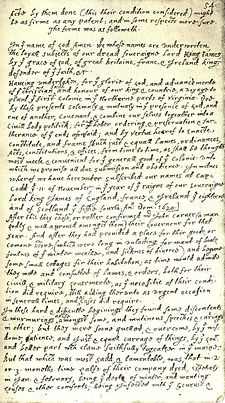
Mayflower Compact
Pilgrims
11/11/1620
An agreement signed by the passengers of the Mayflower before they disembarked at Plymouth. Drafted primarily by the Pilgrims, it established a self-governing colony based on majority rule and mutual consent, with signers pledging to create “just and equal laws” for the good of the community.
Ordinances for Virginia
James I
07/24/1621
The Virginia Company issued the Ordinances for Virginia, a sweeping constitutional framework designed to formalize governance in the colony following years of instability, conflict, and administrative experimentation. The ordinances established a more structured system of local self-government in Virginia, refining the role of the governor and council while expanding mechanisms for colonial participation in lawmaking and marking a key step in the evolution of representative institutions in English America.
Grant of Maine 1622
James I
08/10/1622
James I of England issued the Grant of Maine, transferring large tracts of land in northern New England to Sir Ferdinando Gorges as part of England’s broader effort to expand and organize colonial settlement in North America following the early Virginia experiments. The grant aimed to expand permanent English colonization, establish proprietary governance, and counter French influence in the region, laying legal foundations for what would later become the Province of Maine.
Biographies

James
Madison
James Madison (1751 – 1836) was an American statesman, political theorist, and Founding Father who played a central role in drafting and ratifying the United States Constitution, earning him the title “Father of the Constitution.” He co-authored the influential The Federalist Papers with Alexander Hamilton and John Jay, helped draft the Bill of Rights, and served as the fourth President of the United States from 1809 to 1817.

James
Monroe
James Monroe (1758 – 1831) was the fifth President of the United States, serving from 1817 to 1825, and was the last of the Founder-Presidents. A veteran of the Revolutionary War, he held numerous offices including senator, governor of Virginia, minister to France, and secretary of state and war under James Madison. His presidency is best known for the “Era of Good Feelings” and the Monroe Doctrine, which asserted U.S. opposition to further European colonization in the Americas.
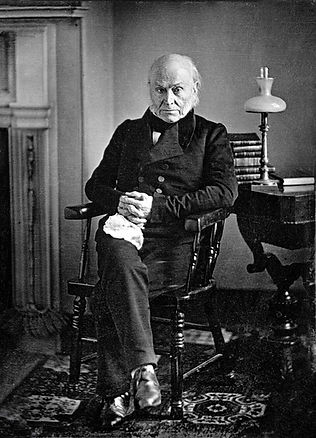
John
Q. Adams
John Quincy Adams (1767 – 1848) was the sixth President of the United States (1825–1829) and the son of second President John Adams. He was a highly educated diplomat who served as minister to multiple European powers and played a key role in negotiating the Treaty of Ghent, which ended the War of 1812. After his presidency, he served for nearly two decades in the House of Representatives, where he became a leading opponent of slavery and a defender of civil liberties.

Andrew
Jackson
Andrew Jackson (1767–1845) was an American soldier, lawyer, statesman, and the seventh president of the United States, serving from 1829 to 1837. Rising from humble origins on the Carolina frontier, he gained national fame as a military commander during the War of 1812, particularly for his victory at the Battle of New Orleans. As president, Jackson expanded popular participation in politics and championed the interests of the common voter, but his legacy remains controversial.